Courtesy of Mish.
I have discussed driverless trucks before, but the timeline keeps speeding up.
Self-driving trucks before the end of this decade used to seem like a remote possibility. It now seems very likely, if not a given. Moreover, driverless truck convoys will be safer and more fuel efficient than human-driven trucks.
“The technology, developed by Peloton Tech, uses radar and a wireless link so that the following trucks travel at the same speed, braking simultaneously for safety, and doing so on an automated system that doesn’t have the delays of human reaction time. In addition, the drivers of both vehicles also have a video display, expanding both drivers’ vision and reducing blind spots,” reports Popular Science in Robot Truck Convoy Tested In Nevada
Trucks Before Cars
Tech Hive reports The First Driverless Cars Will Actually be a Bunch of Trucks.
The future of driverless driving is all about trucks. So forget about that sensor-equipped Volkswagen Passat, and get ready for a 40-ton Peterbuilt 18-wheeler.
In the wake of new U.S. Department of Transportation guidelines for automated-vehicle testing, experts such as Ümit Özguner, a professor with Ohio State University’s Center for Automotive Research, are predicting that the first wave of operational autonomous vehicles will be devoted to long-haul deliveries. This is about moving cargo, not people.
“The trucking industry is very interested in going from single trucks to convoys of trucks. One human driver with perhaps three other trucks behind it,” Özguner told TechHive. “Those three wouldn’t necessarily have a driver in them. Eventually you could imagine removing the first driver too.”
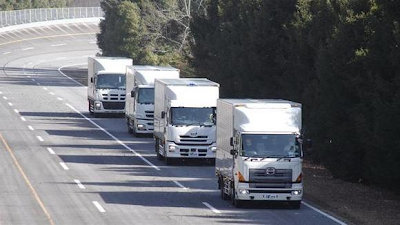
[above]: A Japanese government research program is now testing driverless truck convoys that are designed to improve fuel economy.
In late May, the U.S. Department of Transportation opened the door for road-testing self-driving trucks by publishing policies for the three states that currently allow driverless vehicles: California, Nevada, and Florida. These guidelines open the door for driverless tests of all kinds. Overseas, meanwhile, experiments with driverless truck convoys—also known as “platoons”—have been under way for years.
“[Long-haul trucking] is the most realistic starting point for the commercial adoption of the technology. The long-haul vehicles have the most to gain, both in terms of safety and economic benefits,” says Mike Baker, the chief engineer at Ricardo UK Ltd, the lead firm of SARTRE. “The fuel savings witnessed by trucks in a platoon has a significant impact on the operating profits of the operator, not to mention the environmental impact of reduced CO2 and emissions.” …