


Courtesy of Pam Martens.
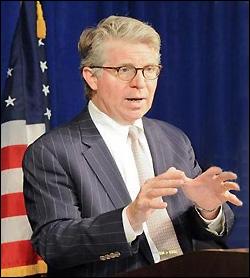
Manhattan District Attorney, Cyrus Vance
Wall Street On Parade has been reporting for the past six months on a series of tragic, sudden deaths of Information Technology workers at JPMorgan. Now coming to the fore are stories of relentless prosecutions of Wall Street’s IT workers by Manhattan District Attorney, Cyrus Vance. Bloomberg News reports today that Vance is engaged in at least four prosecutions of Wall Street workers over theft of computer code or other intellectual property.
Bestselling author, Michael Lewis, devoted a significant part of his latest book, Flash Boys, to the prosecution of Sergey Aleynikov over alleged stolen computer code. Aleynikov had been working for Goldman Sachs when he received an offer to move to a hedge fund and build a system from scratch. Aleynikov accepted the offer but agreed to stay at Goldman for six weeks to train his colleagues. (That does not seem like the action of a person on the run with stolen computer code.)
That was 2009. For the past five years, Aleynikov has been arrested and jailed by the Feds, had his conviction overturned by the Second Circuit Appeals Court, rearrested by the Manhattan District Attorney Cyrus Vance, and now faces more prosecution over the same set of facts: namely, that he took computer code that belonged to Goldman Sachs. Aleynikov is said to be among the best coders in the industry. He is increasingly being seen as the victim of malicious prosecution at the behest of the powerful Goldman Sachs.
According to the Lewis book, on the very same day that Kevin Marino, Aleynikov’s lawyer, gave his oral arguments to the Appeals Court, “the judges ordered Serge released, on the grounds that the laws he stood accused of breaking did not actually apply to his case.” He had been in prison for a year.
When the Second Circuit Appeals Court handed down its opinion of the case in December 2010, it found that Aleynikov had neither taken a tangible good from Goldman nor had he stolen a product involved in interstate commerce – noting that at oral argument the government “was unable to identify a single product that affects interstate commerce.”
…

