


Courtesy of The Automatic Earth.

Fritz Henle “Air raid rules”, West Danville, Vermont July 1942
My, what a lovely day. Summer’s here. Then again, not so great perhaps if yours is one of the 18,000 jobs lost at Microsoft. Then again again, at least the move made Microsoft shares rise. Not anywhere near great if you, or someone close to you, were among the 300 or so on the passenger plane from Amsterdam that got downed just now over Ukraine. Still don’t like the role the US is playing in that conflict. Not a great day either for investors, losses are starting to add up in the stock market. And you have to wonder what Janet Yellen thinks – and many with her – about the devastating free fall in US housing starts, which seems to lay to rest most – but never all – the talk about a recovery. Building permits fell as well. Bloomberg kind of suggests maybe Yellen already knew these numbers when she spoke to the Senate this week:
Housing Starts in US Decline Amid Plunge in the South
Beginning home construction unexpectedly declined in June to a nine-month low as a record plunge in the South swamped gains in the rest of the U.S. Housing starts fell 9.3% to an 893,000 annualized rate, from a 985,000 pace in May that was weaker than initially estimated, figures from the Commerce Department showed today. Construction slumped 29.6% in the South to a 375,000 pace, the weakest in almost two years. The figures, along with a decline in building permits, corroborate Federal Reserve Chair Janet Yellen’s view that progress in the housing market has been “disappointing” this year.
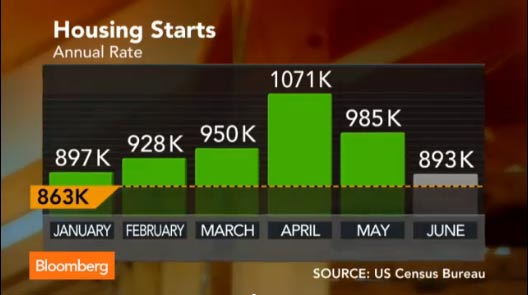
Must be winter in June. If you would go back to all the things that were written and said about how the pent-up demand would lift the US after its Siberian one in a lifetime winter, and how Q2 GDP numbers would rise like a phoenix from the ashes of the Q1 disaster, if you read all that again today, you would get a picture of just how distorted – or should we say non existent – predictive qualities among analysts and reporters have become. Predictions and estimates are now habitually so far off the mark it’s gotten absolutely embarrassing for those of us who follow them. Since most people don’t, the geniuses who produce them may not even care much.
Something else you can bet they’ll get painfully wrong, along with a vast majority of the investment world, is the future of the US dollar. They’ll undoubtedly say nobody could have possible seen this coming; we know the MO.
Since Janet Yellen, and her Fed colleagues, look determined to go ahead with the taper, and end it in a few months, it’s probably wise to take note of these words from Bloomberg:
“Almost 90% of the $5.3 trillion a day in foreign-exchange transactions last year involved the dollar, BIS data show. More than 80% of trade finance was done in dollars in 2013 … “
This is wise because while the Fed is set to substantially shrink the amount of dollars available in global markets, emerging economies have built their entire forward models on the dollar glut provided by QE3. And most world trade, obviously, is also still conducted in USD. This is not a margin call, it’s a margin scream. The demand for the US dollar will rise precipitously, at precisely the time that there’ll be far fewer of them available. This means mayhem in many developing nations, and it means the USD is set to surge. Ambrose Evans-Pritchard is dead on in that respect:
Fed Kicks Off Global Dollar Squeeze As Janet Yellen Turns Hawkish
The US Federal Reserve has begun to pivot. Monetary tightening is coming sooner than the world expected, with sober implications for overheated bourses, and for those in Asia, eastern Europe and Latin America that drank deepest from the draught of dollar liquidity. We can expect a blistering dollar rally, perhaps akin to the early 1980s or the mid-1990s. It is fortuitous that the BRICS quintet of Brazil, Russia, India, China and South Africa have just launched their $100bn monetary fund to defend each other’s currencies. Some of them may need it.
Since Fed chief Janet Yellen targets jobs above all else, this was bound to force capitulation by the Fed before long. It happened this week in her testimony to Congress. “If the labour market continues to improve more quickly than anticipated, then increases in the federal funds rate likely would occur sooner and be more rapid than currently envisioned,” she said. This is a policy shift. Mrs Yellen has admitted that the Fed misjudged the pace of jobs recovery. The staff did not expect unemployment to fall this low until late next year. The inflexion point has come 15 months early. [..] “They may have left it too late again: the risk is a reckoning point when rates rise abruptly,” said Jens Nordvig, from Nomura.
At first glance, it’s delightfully ironic that US manipulation of its own unemployment numbers would lead to this. But perhaps there’s more going on behind the veil.
Mrs Yellen added the usual caveats about “false dawns”. Wages are barely rising. The jobs market is not yet drawing back the millions who dropped out of the system. [..] “The recovery is not yet complete. We need to be careful to make sure the economy is on a solid trajectory before we consider raising interest rates,” she said. Yet she has undoubtedly changed gear. She no longer dismissed rising inflation (1.8%) as “noise”. [..] “Valuations appear stretched. We are closely monitoring developments in the leveraged loan market …”
The critics may be getting to her. The Bank of International Settlements has rebuked the Fed for stoking asset bubbles. Some of her own voting committee are fretting. “I think we are going to overshoot on inflation,” said St Louis Fed chief James Bullard. Mrs Yellen is not as dovish as believed, in any case. Her lodestar is the “non-accelerating inflation rate of unemployment” (NAIRU), the point at which tight labour markets start to drive a wage-price spiral. She thinks this is near 5.4%.
I don’t know, Ambrose. A wage-price spiral for burger flippers and WalMart greeters? I mean, we saw today that it’s highly unlikely there’ll be one for construction jobs …
[..] … if America is strong enough to withstand rate rises, it is far from clear what this will do to the rest of the world. A vast wash of dollars flooded the global financial system when the Fed cut rates near zero and then bought $3.5 trillion of bonds. This may now go into reverse.
My guess is neither is strong enough for rate rises. Or, to be more specific, in both America and abroad, the more affluent will be fine, especially since they are the ones who raked in the “wash of dollars”. For the rest of us, rate rises will be an unmitigated disaster. Low rates are the only thing that has held this caboose together, or seemed to have done so. Low rates have propped up stock markets, mergers, the housing market, you name it.
When governments and companies and individuals, all of whom, certainly in the US and EU, are deeper in debt than ever before in history, by a wide margin, all have to start paying – much – higher interest rates on their debt, the impact will be scorched earth.
We still live in a dollarised world. Charles de Gaulle railed against the “exhorbitant privelege” of US dollar hegemony in the 1960s, but remarkably little has changed since. The BIS says global cross-border lending by banks alone has risen from $4 trillion to $10 trillion over the past decade, and $7 trillion of this is denominated in dollars. This does not include the dollar bond markets. What the Fed now does arguably has more amplified effects than at any time since the end of gold and the collapse of the fixed-exchange Bretton Woods regime in 1971. This is the paradox of 21st century globalisation.
Much of the dollar business is conducted through European and UK banks, leaving them acutely vulnerable to a dollar squeeze. Such episodes can be ferocious. It was a dollar liquidity shock that turned the Lehman affair into a global banking crisis, instantly engulfing Europe in October 2008. Emerging markets went into a tailspin last year at the first suggestion of Fed bond tapering. There was a sudden stop in capital flows. The “Fragile Five” (India, Indonesia, South Africa, Brazil and Turkey) were punished for current account deficits. The Fed backed down. The storm passed. There was a second “taper tantrum” earlier this year as the Fed finally began to pair back its $85bn monthly purchases under QE3. This too settled down.
When everyone save for America must pay – significantly – more for the US dollar, and more for the commodities – oil! – and loans and everything else that are denominated in dollars, the damage becomes hard to oversee. So much of this is conducted through short term loans – letters of credit come to mind – that must be rolled over all the time, and now almost all parties involved will increasingly have to scramble to find dollars somewhere, anywhere. Outright panics can easily follow.
[..] A study by the International Monetary Fund concluded that the Fed’s QE had pushed $470bn into emerging markets that would not otherwise have gone there. IMF officials say nobody knows how much of this hot money will come out again, or how fast. The BIS in turn said in its annual report two weeks ago that private companies had borrowed $2 trillion in foreign currencies since 2008 in emerging economies, lately at a real rate of just 1%. Loans to Chinese companies have tripled to $900bn – some say $1.2 trillion – mostly through Hong Kong and often disguised by opaque swap contracts in what amounts a dangerous carry trade. Countries do not borrow in dollars any longer (mostly) but their banks and industries certainly do.
China is, as we speak, seeing its second bond default in short order, with the added twist of this one taking place in the interbank market. There is no doubt the US dollar is heavily involved in that market. What happens in China’s opaque finance world when the dollar rises and rates go up must be keeping a few of the smarter people over there awake already.
The report said monetary largesse in the West has destabilised emerging economies in all kinds of ways. One of the worst – and least understood – ways is that they were forced to choose between internal credit bubbles or surging currencies. Most opted for bubbles as the lesser evil, holding their domestic interest rates at 300 basis points below the safe “Taylor Rule” level. This has driven their total debt levels to a record 175% of GDP. It may be even worse. China has thrown all caution to the wind, pushing credit from $9 trillion to $25 trillion since Lehman. Its debt levels have reached 220% by some estimates.
Record debt levels encouraged by cheap and readily available dollars. Which will now become less available and much less cheap.
[..] .. there is no denying that a long string of countries are in structural crisis, ensnared by the middle-income trap. They have exhausted the low-hanging fruit of catch-up growth. They failed to carry market reforms to varying degrees. [..] .. these countries – and many others with parallel problems, must brace for a secular rise in global borrowing costs, and as the BIS warns, the world is today more sensitive to interest rates than ever before. As yields on two-year US Treasuries ratchet higher, the US currency will inevitably ratchet with it. “I am convinced that we are close to a major cyclical recovery for the dollar,” said Nomura’s Mr Nordvig.
The BRICS, the mini-BRICS and much of global finance have taken out a colossal short position on the US dollar. Mrs Yellen has just issued the first margin call.
What else is there to say? Welcome to the new world order?! Europe may have long been complaining about the high euro, but is it ready for the super dollar? I think not. How many dollar denominated potential problems are there in Greek, Spanish. Italian banks? Do the ECB stress tests include a rate rise to 5% from 1%? A dollar on par with the euro? China has all the potential for 1001 smaller crashes adding up to a major bust. Beijing won’t be able to keep track of every single problem anymore, but every single one may grow from level 1 to 10 in no time. Most emerging nations are just plain toast.
Ambrose is right: the entire world has survived – even thrived – on a huge short on the US dollar for the past 5 years or so. And now the punch bowl threatens to be kicked away from right under their thirsty slurping snouts. Are we to think the Fed never saw this coming? What if they did? Is there a plan here?

