


Courtesy of The Automatic Earth.

Warner Bros Lauren Bacall publicity still from To Have and Have Not 1944
If you put all the pieces in a jigsaw puzzle in their proper places, a picture emerges. An easy enough principle. But how do you get the pieces, and where do they go? That’s often not so easy at all.
Oil prices are low, and falling, in the face of Iraq and Ukraine. But what does that mean, and how does it fit into the puzzle?
In a report issued on Tuesday, the IEA cut its forecast for worldwide oil consumption growth to 1 million bpd (barrels per day), 180,000 bpd less than previously predicted, while supplies have risen by 300,000 bpd above the forecast output.
Now, the IEA and its US sister, the EIA, are notoriously as unreliable in their numbers as the US government is in jobs and growth numbers, and as China is in all economic numbers. But the trend looks believable.
And to think that only in March the IEA predicted increasing demand and said: “Growth momentum is expected to benefit from a more robust global economic backdrop”.
One thing from the IEA report makes sense; it says the oil market seemed “eerily calm in the face of mounting geopolitical risks spanning an unusually large swathe of the oil-producing world”.
Russia Vulnerable As Oil Prices Hit Nine-Month Low On IEA ‘Glut’ Warnings
Oil prices have fallen to a nine-month low as surging supply from Opec and the US floods the market and fresh demand wilts [..] OECD inventories rose by 88m barrels in the second quarter, the most since 2006. Stocks are still below their five-year average but are no longer as dangerously thin as they were last winter.
[..] Saudi Arabia cranked up its production to more than 10m b/d, the highest since last September. Oil demand fell by 440,000 b/d in Europe and the US over the period [..] The big surprise has been a “sharp contraction” in German demand for oil products, down 3.9pc over the past year. It is much the same picture in Italy and Japan.
I find it curious that Saudi Arabia would raise its production in times when there is an oil ‘glut’. What would they be trying to achieve? Lower prices? For political reasons perhaps? It gets more curious when the EIA says OPEC will reduce production, as per the Wall Street Journal:
EIA Lowers Global Oil Demand Forecast for 2014, 2015
The EIA said it expects the Organization of the Petroleum Exporting Countries to reduce output in 2014 [..] The agency called for 35.84 million bpd of OPEC production in 2014[ ..] OPEC produced 36.12 million bpd last year, according to the EIA. In the U.S., production hit 8.5 million bpd in July, the highest monthly level since April 1987 [..] its forecast total U.S. crude production at 8.46 million bpd in 2015 However, the agency cut its forecast for production in the lower 48 states.
The EIA maintained its forecast for U.S. average daily oil consumption at 18.88 million bpd in 2014 but raised its 2015 forecast to 18.98 million bpd.
The glut can come from either one of two directions: more supply or less demand. Since demand fell by 440,000 b/d in Europe and the US since September, and the IEA says production will rise by 300,000 bpd, there is some wiggle room. But.
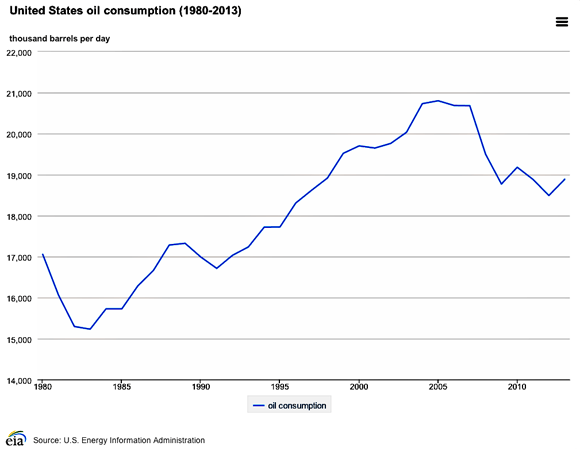
US oil consumption never recovered. It’s now at about the same level as in 1997, when there were about 45 million fewer people living in America. That is a huge drop. While there have been advances in efficiency etc., there’s no denying that the economy never recovered either, not by a very long shot. No matter that it supposedly grew at a 4% annualized rate in Q2…
And please don’t forget that this happened at a time when stock markets set records, the Fed balance sheet rose to $4+ trillion and overall debt went to the moon and never looked back. What is that, a quadruple whammy?
Worst Retail Sales Showing in Six Months in Slow Start to Third Quarter
Retail sales were little changed in July, the worst performance in six months, as car demand slowed and tepid wage growth restrained U.S. consumers. The slowdown in purchases followed a 0.2% advance in June [..]
Retailers such as Macy’s are relying on promotions and discounts to entice customers. “There’s no sign of momentum or enthusiasm out of the consumer right now,” said Stephen Stanley, chief economist at Pierpont Securities [..] I don’t think people have the wherewithal, not to mention the inclination, to ramp it up.”
Not even subprime car loans can do the trick anymore. Let alone housing:
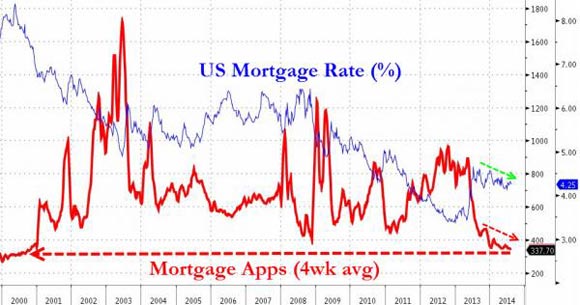
Not that that’s a typical American problem:
Home sales in China fell 10.5% in the first seven months of the year to 2.98 trillion yuan ($484 billion) [..] To lure home buyers back to the market, around 30 local governments have loosened property restrictions such as limits on second home purchases. But there has yet to be any meaningful pickup in sales [..] Average home prices in 100 Chinese cities fell for the third straight month in July on a month over month basis, according to data tracker China Real Estate Index System. New construction starts in the January-July period measured by area fell 12.8%
Nor is the US the only country with a retails sales problem:
Japanese GDP Plunges 6.8%, Record Drop in Consumer Spending
Compared to the 3.6% drop in GDP when Japan last hiked its consumption tax in 1997, today’s Q2 GDP collapse of 6.8% annualized is an utter disaster. Consumer Spending collapsed 5.2% QoQ – the most on record.
And Europe fares no better:
Crisis Stalks Europe Again As Deflation Deepens, Germany Stalls
Portugal has crashed into deep deflation and Italy’s inflation rate has fallen to zero as the eurozone flirts with recession, automatically pushing these countries further towards a debt compound spiral. The slide comes amid signs of a deepening slowdown in the eurozone core, with even Germany flirting with possible recession. Germany’s ZEW index of investor confidence plunged from 27.1 to 8.6 in July, the sharpest fall since June 2012 [..]
Markets were stunned by the sudden fall in Portugal’s HICP inflation to -0.7% in July, from -0.2% the month before. Spain’s provisional estimate is for a fall of -0.3%. The risk is that this will cause inflation expectations to become unhinged and extremely difficult to reverse.
“The latest inflation figures call for the ultimate bazooka from the ECB. We’re seeing the Japanification of Europe,” said Lena Komileva from G+ Economics. “Deflation pushes up the debt ratios in the southern countries and makes their task even more insurmountable.”
Morgan Stanley warned that Germany’s economy contracted by 0.1% in the second quarter [..] Hans Redeker, the bank’s currency chief said: “It is very difficult to keep recovery going in the eurozone without credit. Companies are just eating up their cash flow.”
Germany’s factory orders from the rest of the eurozone dropped by 10.4% in June [..] The DAX index of stocks in Frankfurt has plummeted 10% over the past month, while yields on 10-year German Bunds have dropped to historic lows of 1.06%.
For Italy, it is already becoming a fresh crisis. The country is caught in a vice, squeezed by a triple-dip recession and zero inflation at the same time. Italy’s €2.1 trillion public debt is rising on a shrinking base of nominal GDP despite austerity policies. The debt ratio has surged five percentage points to 135.6% of GDP over the past year, despite austerity. Portugal is close behind. Its debt has jumped from 127.4% to 132.9% [..] Deflation is pushing both nations into a textbook debt trap.
And then we haven’t even talked about France. Or fresh sanctions that will bite a piece out of GDP both in Russia and in Europe.
Without the markets, or economies, collapsing outright yet, it’s starting to look like while oil cannot save us from economic mayhem, the downfall of our economies is indeed keeping the lack-of-energy monster at bay.
Not that that’s something we should be too happy about, for obvious reasons.
But that’s not the whole story, or the end of the story, and it’s not where the jigsaw pieces fall neatly into place.
What we tend to label geopolitical risks, which will come in very handy to mask economic problems we would have had anyway, are already leading to other events and consequences.
That is to say, the world has started fighting over oil for real. It’s no longer just about dominance, it’s about survival. Of societies, of values, political systems, religions.
Islamist State Funds Caliphate With Mosul Dam, Oil and Gas
Islamic State militants who last week captured the Mosul Dam, Iraq’s largest, had one demand for workers: Keep it going. [..] militants from the al-Qaeda breakaway group told workers hiding in management offices they would get their salaries as long as the dam continued to produce electricity for the region under their control.
[IS] fighters are capturing the strategic assets needed to fund the Islamic caliphate [..] “These extremists are not just mad,” said Salman Shaikh, director of the Brookings Institution’s Doha Center in Qatar. [..] “It’s been a big mistake for some people to think that these guys are some ragtag outfit .. ” [..] “There’s a method to their madness, because they’ve managed to amass cash and natural resources, both oil and water, the two most important things. And of course they are going to use those as a way of continuing to grow and strengthen.”
The dam is the most important asset the group captured since taking Nineveh province in June. The group controls several oil and gas fields in western Iraq and eastern Syria, generating millions of dollars in daily revenue. The group is using the dam as a hideout because it knows it wouldn’t be bombed, he said [..] The dam was completed in 1986 and its generators can produce as much as 1010 megawatts of electricity, according to the website of the Iraqi State Commission for Dams and Reservoirs.
Aziz Alwash, an environmental adviser to the Water Resources Ministry, said the dam needs cement injections as part of its maintenance. “Mosul city would drown within three hours” if the dam broke, he said Aug. 10 in a telephone interview. Other cities down the road to Baghdad would also be inundated while the capital would be under water within four hours.
While you were sleeping, the world changed. Our economies are no longer growing. But some things are. The Islamist State for one. International tension in general. And “We” are actively causing these things to grow as much as anyone else.
It should be crystal clear that oil prices can shoot up at any given moment. One wrong move, one faulty calculation, one missed shot or one stray bullet, that’s all it takes. We like to think of ourselves as being in control, that’s how we grew up. But we no longer are, if we ever were.
Someone at CNBC found a few pieces that fit together:
Are Weaker Oil Prices Signaling Doom For Stocks?
The price of Brent crude slipped to a 13-month low on Wednesday, pushed lower by reports of oversupply in the markets. However, some market watchers believe that this softness could be signaling something more sinister in the global economy, with a risk that the weakness could spread to other assets. [..] Michael Hewson, analyst at CMC Markets, agrees that current global growth forecasts may be too optimistic and depressed demand in Europe and China, along with the anticipated normalization of interest rates in the U.S. and the U.K., could be about to bring investors back down to earth.
[..[ he has felt the market has been too upbeat for most of 2014. “Far be it from me to get in front of a runaway train … but I think that train is a bit crowded.”

