


Courtesy of Pam Martens.
The time and effort spent by members of the Federal Reserve Board of Governors debating the timing of rate hikes is an utterly wasted exercise in futility – and the historically astute members of the Fed know it. After eight solid months of blathering about when rate hikes might occur, the real muscle in the bond market – the bond vigilantes – are drawing their own conclusions about what is coming down the pike.
The benchmark 10-year U.S. Treasury note has moved from a yield of 2.85 percent at the beginning of the year to close last week at 2.38 percent. That’s the reaction of a market more worried about constrained income dispersal in the U.S. causing deflation than a market bidding up yields in anticipation of a rate hike.
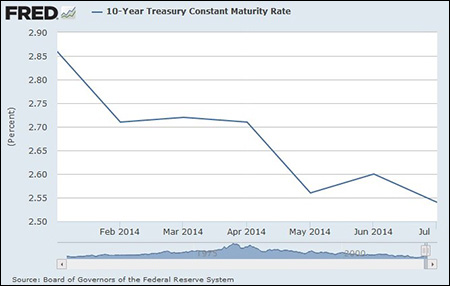
10-Year U.S. Treasury Note Yield Is Ignoring Fed Talk of Rate Hikes
In early August, the Fed’s own scholars released a report showing just how fragile the U.S. economy remains as a result of Wall Street’s continuing, institutionalized wealth transfer system. The Fed’s Division of Consumer and Community Affairs found that 52 percent of Americans would not be able to raise $400 in an emergency by tapping their checking, savings or borrowing on a credit card which they would be able to pay off when the next statement arrived.
As we have argued repeatedly at Wall Street On Parade, there is a finite equilibrium of income distribution at which the U.S. economy, or any other economy, can sustain momentum without artificial stimulus. In the U.S., 70 percent of U.S. Gross Domestic Product (GDP) is consumption. When workers are stripped of an adequate share of the nation’s income, they cease to be the levers of economic growth.
Not a week goes by that we don’t hear about another retail chain closing stores; last week it was Staples announcing the closing of 140 stores while Sears reported it had lost $975 million in just the first six months of the year.
…

