


Courtesy of Pam Martens.
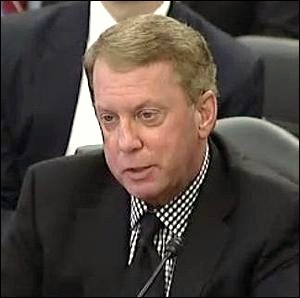
Terrence Duffy of the CME Group Testifying Before the Senate on May 13, 2014
Remember the Senate hearing on June 18 when Senator Elizabeth Warren talked about the high frequency trading firm, Virtu, reporting in its IPO prospectus that it had been trading for 1,238 days and made money on 1,237 of those days. Last week three futures traders told a Federal court in Chicago that it’s not just the high frequency trading firms that are reaping a windfall but the exchanges who are engaged in a conspiracy with them to create “guaranteed winners and guaranteed losers.”
The original lawsuit was filed on April 11 against the CME Group and four of its officials in the U.S. District Court for the Northern District of Illinois. The CME Group owns the Chicago Mercantile Exchange (CME), the largest futures exchange in the world. Terrence (Terry) Duffy, the Executive Chairman and President of the CME Group, a man who has testified before Congress that his exchanges have nothing to do with the charges of rigged markets that are swirling about, is a named defendant in the suit.
Last week lawyers for the plaintiff traders filed a Memorandum of Law to ward off efforts by CME Group’s attorneys to have the case dismissed for lack of specificity. Citing a case known as U.S. v. Snow, the plaintiffs respond that “conspiracy by its very nature is a secretive operation, and it is a rare case where all aspects of a conspiracy can be laid bare in court with … precision.”) Notwithstanding that, many of the charges laid before this court have been quite detailed and named names, such as the following:
“Defendants have entered into clandestine incentive/rebate agreements in established and heavily traded contract markets with favored firms such as DRW Trading Group and Allston Trading, paying up to $750,000.00 per month in one of the most heavily traded futures contracts in the world. At no time during the Class Period have Defendants voluntarily revealed to the trading public that these material agreements exist in established markets. Defendants through their lawyers have repeatedly ridiculed the suggestion that clandestine agreements exist.”
The traders bringing the lawsuit, which is filed as a class action, are William Charles Braman, Mark Mendelson and John Simms. Under the law, exchanges must function as quasi regulators, guaranteeing that the exchanges are free of manipulative or discriminatory practices – in other words, that everyone has a level playing field. But what Judge Charles P. Kocoras has been hearing in this case for months are these hair-raising charges of “clandestine” contracts between the futures exchanges and high frequency traders; that the exchange is giving high frequency traders early peeks at data before the rest of the market under a process known as the “Latency Loophole”; and that potentially as much as 50 percent of the trades on the exchange are “wash trades.”

