

Courtesy of Pam Martens.
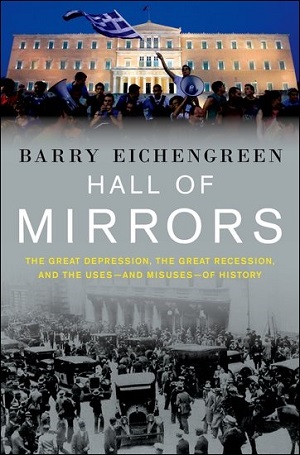
Barry Eichengreen, Professor of Economics and Political Science at the University of California, Berkeley, has written an essential tome contrasting the Great Depression of the 1930s with the Great Recession that began in late 2007 and deepened with the collapse of iconic Wall Street firms in 2008. Aptly titled Hall of Mirrors: The Great Depression, the Great Recession, and the Uses and Misuses of History, the book walks us through ongoing events in the U.S. and Europe during both periods.
Professor Eichengreen’s book is well worth reading for the mining of nuggets such as this: “Between 1933 and 1937, real GDP in the United States grew at an annual rate of 8 percent, even though government did only passably well at these tasks. Between 2010 and 2013, by comparison, GDP growth averaged just 2 percent.”
In just two sentences the Professor has encapsulated the timidity of the fiscal response to the crisis and why the word “deflation” is now, six years after the peak of the crisis, gathering steam in headlines.
Amazon.com has the book listed as the number 1 bestseller in public policy. The book is published by Oxford University Press, which wants you to know that it’s a department at the University of Oxford, furthering the University’s “objective of excellence in research…” Professor Eichengreen thanks no less than 39 academics whom he consulted on the manuscript or were helpful in some other way to his writing.
Sadly, neither Professor Eichengreen nor his fellow academics caught this fatal flaw in the book:
“Lehman was not a commercial bank; it did not take deposits. It was thus possible to imagine that its failure might not precipitate a run on other banks like the runs triggered by Henry Ford’s Guardian Group of banks in 1933.”
…

