


Courtesy of Pam Martens.
 On October 23, 2008, with much of Wall Street lying in ruins and the U.S. economy rapidly heading toward a 1930s type of collapse, Henry Waxman, Chair of the House of Representatives’ Oversight Committee, attempted to elicit answers from Alan Greenspan, the former Chair of the Federal Reserve for an unprecedented 18 years who had pushed for the deregulation of Wall Street that had left the country teetering.
After enumerating a series of recent financial collapses occurring from either deregulation or corrupted business principles, Waxman said:
“Each of these case studies is different, but they share common themes. In each case, corporate excess and greed enriched company executives at enormous cost to shareholders and our economy. In each case, these abuses could have been prevented if Federal regulators had paid more attention and intervened with responsible regulations.”
In those three sentences, Waxman had correctly indicted a lifetime of writing and theories espoused by Ayn Rand and her acolyte, Alan Greenspan. Rand’s theory is simpleminded and destructive – on both the personal and societal level. It holds that the selfish desires of the individual should have no restraints by government; the poor deserve their lot and should receive no tax support from other citizens while the rich have a right to unrestricted power.
 Greenspan not only worshiped at the feet of Rand but wrote essays for her “Objectivist” newsletter and contributed articles for her book Capitalism: The Unknown Ideal. One of Greenspan’s articles in the book is titled “Antitrust.” Greenspan makes the same simplistic and deluded case as Rand that if government will only get out of the way, corporate leaders will move the country forward…
[…]
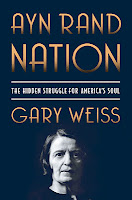
In addition to writing for Rand, Greenspan was a member of her “Collective” in New York City. Gary Weiss wrote about the “Collective” in his book Ayn Rand Nation: The Hidden Struggle for America’s Soul. According to Weiss, “For much of its existence the Collective was for all intents and purposes a cult. It had an unquestioned leader, it demanded absolute loyalty, it intruded into the personal lives of its members, it had its own rote expressions and catchphrases, it expelled transgressors for deviation from accepted norms, and expellees were ‘fair game’ for vicious personal attacks.”
At the October 2008 Congressional hearing, when Congressman Waxman was finally able to get Greenspan to address how he had been blindsided to the craven corruption building right under his nose, leading to an epic collapse of the economy and Wall Street in 2008, Greenspan replied:
“So the problem here is something which looked to be a very solid edifice, and, indeed, a critical pillar to market competition and free markets, did break down. And I think that, as I said, shocked me. I still do not fully understand why it happened and, obviously, to the extent that I figure out where it happened and why, I will change my views. If the facts change, I will change.”

