

Courtesy of Pam Martens.
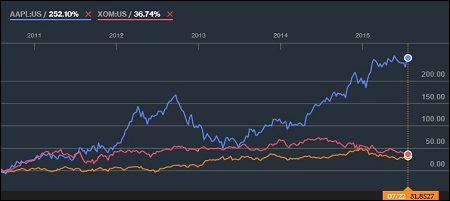
Procter and Gamble (Orange) and ExxonMobil (Red) Share Price Versus Apple (Blue) Share Price Since 2011
By Pam Martens and Russ Martens: July 22, 2015
We truly pity the earnest stockbroker today. Imagine trying to have a sensible conversation with your client about what’s going on in world markets when almost nothing makes sense anymore.
It is an inherent underpinning of “free markets” that they must remain open for trading during regular market hours unless there is a catastrophic event like war or a terrorist attack. Even after the Tuesday, September 11, 2001 event when planes flew into two World Trade Center towers, leaving much of lower Manhattan covered in rubble and a jungle of tangled, destroyed electronic cables, the New York Stock Exchange reopened the following Monday.
But here we are with no war (other than a war of words) and no terrorist attack and yet Greece’s stock market has been closed for more than three weeks. China is officially reporting that it is experiencing 7 percent economic growth but 20 percent of its stocks on its stock exchanges remain halted from trading and commodity prices are collapsing, a further sign of a serious slowdown in the world’s largest raw-commodity consuming country.
And while the U.S. stock markets are indeed trading, far too much of these markets is trading in the dark. Take the shares of Apple, for example. According to the Financial Industry Regulatory Authority (FINRA), which only began reporting dark pool trading to the public on June 2 of last year, during the week of June 22, 2015, there were 17.7 million shares of Apple traded in dark pools. (That’s the most recent full week of dark pool trading reported by FINRA; it releases data on a delayed basis.) The largest dark pool trades in Apple that week were in dark pools owned by mega global banks UBS, Credit Suisse, Merrill Lynch, JPMorgan and Goldman Sachs.
…

