


Courtesy of Pam Martens
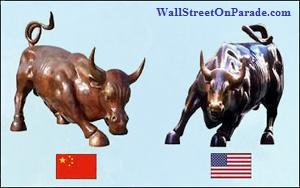
Shanghai’s Bull Statue on Its Bund Waterfront (left); Bull Statue in Lower Manhattan (right)
By Pam and Russ Martens
U.S. stocks felt their worst selloff in 18 months yesterday with the Dow Jones Industrial Average losing 358 points and the S&P 500 index shaving off 43.88 points. Of particular concern, the S&P has now broken through its 200-day moving average which suggests to market technicians that more pain is ahead.
The stock plunge set off a flight to safety with money flowing into the 10-year U.S. Treasury note, driving down the yield. This morning, the U.S. 10-year paper is sporting a yield of 2.06 percent. Despite persistent talk of a rate hike coming out of the Federal Reserve, the yield on the 10-year has been declining for months, not rising – suggesting that the markets believe the Fed is reading the wrong tea leaves.
On the heels of the sea of red in U.S. markets yesterday, China’s stock markets sold off further Friday. The Shanghai Composite lost 4.3 percent while the Shenzhen was off by 5.4 percent. The ChiNext Price Index of smaller companies closed down 6.65 percent. It now appears that the Chinese government is only prepared to support stock prices to prevent an outright crash, but is not prepared to prop up the market on a daily basis. That would bleed its treasury coffers rather rapidly, given the extent of investors heading for the exits in China.
Adding to global worries, a preliminary Caixin/Markit China Manufacturing Purchasing Managers’ Index released on Friday showed further weakness in the Chinese economy. The Index for August came in with a reading of 47.1 versus July’s 47.8. There is growing conviction among economists that China is not growing at the officially declared rate of 7 percent, but at a rate considerably lower. The stock rout extended to Japan with its Topix 500 dropping 3.13 percent.
…

