


Courtesy of Pam Martens.
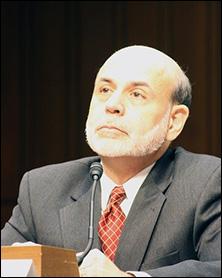
Former Fed Chair Ben Bernanke: What Did He Know and When Did He Know It
Will the American people ever get an honest writing of the 2008-2009 Wall Street collapse? If you think it is to be found in the new book released on Monday by former Fed Chairman Ben Bernanke (which we seriously doubt you are thinking) you will be disappointed.
What you will find in Bernanke’s book are photos of his grandparents, a photo of the Time Magazine cover with himself named “Man of the Year,” a photo of Bernanke with the masterminds of the repeal of the investor protection act known as Glass-Steagall (Robert Rubin, Alan Greenspan, Larry Summers), a photo of the grand double staircase in the Federal Reserve building, and so forth.
What you will not find is an honest accounting of how the Fed allowed Citigroup to grow into a financial Frankenstein and then quietly and secretly shoveled trillions of dollars into the firm to keep it afloat.
You won’t find any of that because on March 3, 2009, former Fed Chairman Ben Bernanke testified under questioning from Senator Bernie Sanders that “the Federal Reserve lends to healthy firms on a collateralized basis…” In reality, Citigroup was a financial basket-case at that point. Its stock closed that day at $1.22. It would take a court battle launched by Bloomberg News and legislation pushed by Senator Bernie Sanders to unearth from the Fed the fact that it had funneled over $16 trillion in cumulative loans to save the financial system. Citigroup was the largest recipient of those loans, with a take of over $2.5 trillion cumulatively, on top of $45 billion in TARP funds and over $306 billion in asset guarantees.
Bernanke’s account in his new book, The Courage to Act: A Memoir of a Crisis and Its Aftermath, attempts to resuscitate the bogus scenario that it was the collapse of Lehman and AIG that set the crisis in motion, not mega banks weakened by lax regulation by the Fed and the repeal of the Glass-Steagall Act, a decision supported by the Fed. (Lehman Brothers, an investment bank, and AIG, an insurance company, were not overseen by the Federal Reserve at that time.)
…

