

Courtesy of Pam Martens.
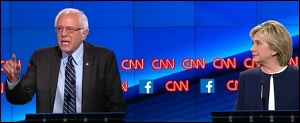
Senator Bernie Sanders and Hillary Clinton at First Democratic Debate, October 13, 2015
In the minds of millions of viewers, Hillary Clinton came across in last night’s Democratic debate on CNN as polished, articulate and knowledgeable about the issues. But for those of us who understand that the greatest threat to America is not some foreign power but home-grown financial terrorists wielding trillions of dollars in high-risk derivatives in taxpayer-insured banks on Wall Street, she is the same old problem, not the solution.
Senator Bernie Sanders of Vermont, on the other hand, who calls himself a Democratic Socialist, was in Congress leading the fight to stop the repeal of the Glass-Steagall Act in 1999 and is still leading the charge to restore it before the next financial crash destroys what’s left of the U.S. economy. (The Glass-Steagall Act prohibits insured banks from being affiliated with high risk investment banks or stock brokerage firms.)
It was during the exchange between Sanders and Clinton on the Glass-Steagall Act that the defining difference between the two emerged: Clinton admits to listening to “experts” who told her that the real danger is not the mega banks but “shadow banking.” She said her plan “is more comprehensive” than Sanders and that it would “empower regulators to break up big banks if we thought they posed a risk.”
The above quote from Clinton is fatal to her candidacy. The “experts” she’s listening to apparently don’t know that regulators have had the ability to break up the big banks since the Dodd-Frank reform legislation was passed in 2010. The regulators just don’t have the guts to take on the Wall Street lobby and their sycophants in Congress. Senator Elizabeth Warren has lectured the Federal Reserve Chair, Janet Yellen, in Senate hearings on using that authority instead of allowing Wall Street mega banks to flunk their stress tests and simply come back the next year and try to get a passing grade.
It’s also fatal to Clinton’s candidacy that she’s bought into the idea that shadow banking is the threat and not the Wall Street banks with $1 to $2 trillion in assets. Yes, their shadow banking customers may get into trouble and threaten their balance sheets, or their shadow banking counterparties may get into trouble and threaten their balance sheets, but it’s the mega Wall Street investment banks with insured deposits backed by the taxpayers that ultimately pose the real threat to the stability of the financial system, the U.S. economy, and the already crushing national debt that exploded to resuscitate the economy the last time Wall Street cratered it in 2008 and 2009.
…

