


Courtesy of Pam Martens.
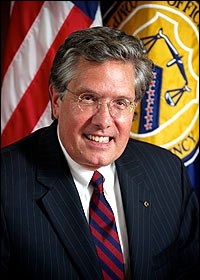
Thomas J. Curry, Comptroller of the Currency
One of the common complaints heard about the U.S. financial regulatory system is that it’s so fragmented that one hand doesn’t know what the other is doing. For example, both the Office of the Comptroller of the Currency (OCC) and the Federal Reserve Board of Governors (Fed) regulate the largest banks – including the biggest banks on Wall Street. But neither of these regulators has any clarity on the securities trading risks that these banks holding trillions in insured deposits are taking. Neither does the FDIC that insures the deposits with backstopping from the taxpayer. That’s the Securities and Exchange Commission’s job. The same banks are also taking big risks in commodities and futures trading – but that’s left to the oversight of the Commodity Futures Trading Commission (CFTC). And on and on it goes.
A speech given yesterday by Thomas J. Curry, Comptroller of the Currency, underscores the dangers of this fragmented system, which effectively allows Wall Street to run wild by hiding systemic risks in the abundant cracks of this system: A system Wall Street itself designed through lobby pressure on Congress and regulators and a gold-plated revolving door.
Curry told his audience at an Exchequer Club luncheon in Washington, D.C. that “we are clearly reaching the point in the cycle where credit risk is moving to the forefront.” Curry’s laundry list of potentially problematic areas included leveraged loans, home equity lines of credit, subprime auto loans, and commercial real estate.
What Curry didn’t mention are the real elephants in the room – the casino room on Wall Street: the $180.29 trillion of derivatives held at the insured banking units of just four banks: JPMorgan Chase, Bank of America, Citibank (part of Citigroup) and Goldman Sachs. Just those four banks hold 91.1 percent of all derivatives held at the thousands of banks in the U.S. If that’s not concentrated risk, we don’t know what is. Curry also didn’t mention the frightening reality that some of the biggest banks are up to their old dirty tricks of dodging capital requirements through trades with dubious counterparties.
In June, the U.S. Treasury’s Office of Financial Research (OFR) released a report that set off alarm bells. The report, written by Jill Cetina, John McDonough, and Sriram Rajan, revealed that the big Wall Street banks are ginning up their capital measures by engaging in non transparent “capital relief trades.”
…

