


Courtesy of Mish.
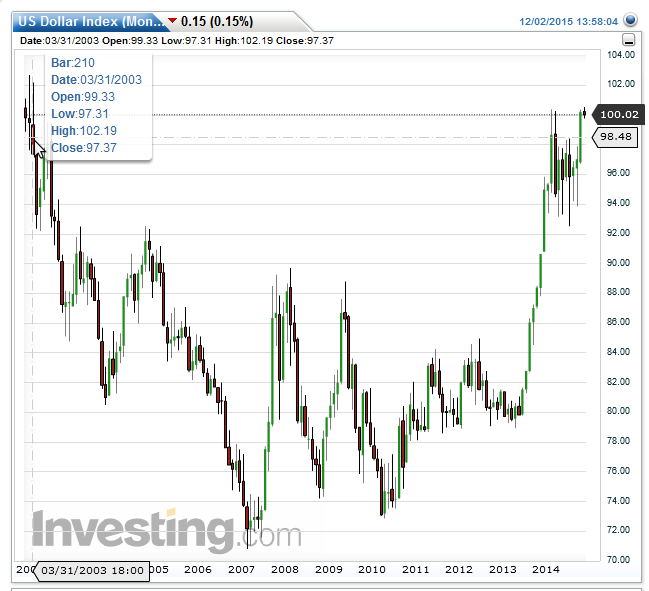
As Fed Chair Janet Yellen yapped about the strength of the US economy in a speech to the Economic Club of Washington, the US dollar index briefly surged above a level set in March, to a high last seen in April of 2003.
US Dollar Weekly
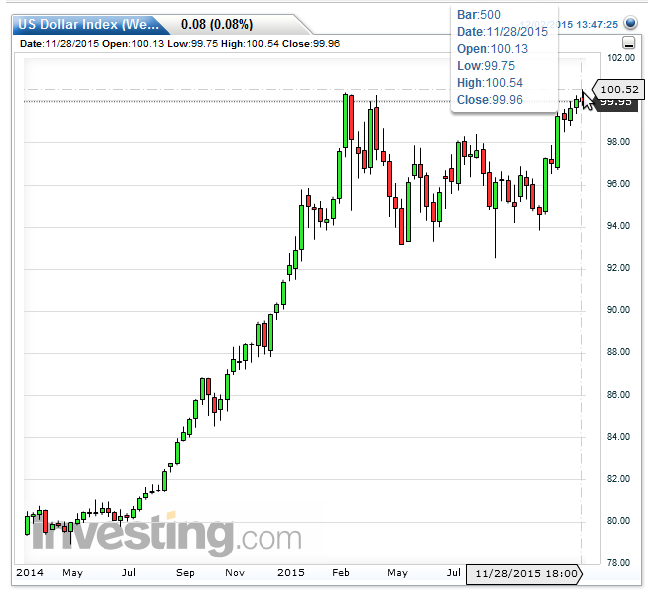
As noted by the last red candle, the US dollar index is now down for the week. The last time the dollar touched as high as it did today was in March of 2003.
US Dollar Monthly
Speech Highlights
Thank you to the Economic Club of Washington for inviting me to speak to you today. I would like to offer my assessment of the U.S. economy, nearly six and half years after the beginning of the current economic expansion, and my view of the economic outlook.
The U.S. economy has recovered substantially since the Great Recession. The unemployment rate, which peaked at 10 percent in October 2009, declined to 5 percent in October of this year. At that level, the unemployment rate is near the median of FOMC participants’ most recent estimates of its longer-run normal level. The economy has created about 13 million jobs since the low point for employment in early 2010, and total nonfarm payrolls are now almost 4-1/2 million higher than just prior to the recession.
I anticipate continued economic growth at a moderate pace that will be sufficient to generate additional increases in employment, further reductions in the remaining margins of labor market slack, and a rise in inflation to our 2 percent objective. I expect that the fundamental factors supporting domestic spending that I have enumerated today will continue to do so, while the drag from some of the factors that have been weighing on economic growth should begin to lessen next year. Although the economic outlook, as always, is uncertain, I currently see the risks to the outlook for economic activity and the labor market as very close to balanced.
Turning to the factors that have been holding down growth, as I already noted, the higher foreign exchange value of the dollar, as well as weak growth in some foreign economies, has restrained the demand for U.S. exports over the past year. In addition, lower crude oil prices have reduced activity in the domestic oil sector. I anticipate that the drag on U.S. economic growth from these factors will diminish in the next couple of years as the global economy improves and the adjustment to prior declines in oil prices is completed.
Although developments in foreign economies still pose risks to U.S. economic growth that we are monitoring, these downside risks from abroad have lessened since late summer. Among emerging market economies, recent data support the view that the slowdown in the Chinese economy, which has received considerable attention, will likely continue to be modest and gradual. China has taken actions to stimulate its economy this year and could do more if necessary. A number of other emerging market economies have eased monetary and fiscal policy this year, and economic activity in these economies has improved of late. Accommodative monetary policy is also supporting economic growth in the advanced economies. A pickup in demand in many advanced economies and a stabilization in commodity prices should, in turn, boost the growth prospects of emerging market economies.
…

