


Courtesy of Pam Martens.
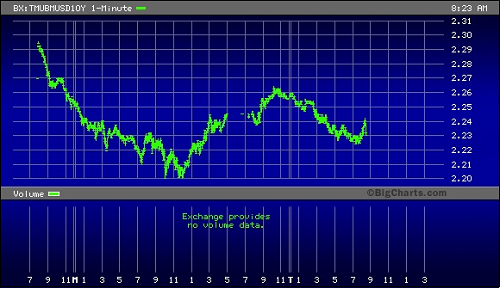
10-Year Treasury Note Yield Action During Monday’s Stock Plunge
From Riyadh to Tehran, Shanghai to Frankfurt, investors had plenty to sweat about yesterday. The culmination of this perfect storm landed in U.S. stock markets yesterday where the Dow Jones Industrial Average was shortly after 11 a.m. off by more than 450 points. The Dow closed the day down 276 points after some kindly buying support exceeding $1 billion from unknown sources came in to prop up the market at the close.
The first weekend ahead of Monday’s stock market open got off to a bad start with trouble spots that are likely to challenge markets throughout this year. Saudi Arabia (a country that still refuses to grant women licenses to drive a car) engaged in mass executions of 47 people, one of whom was a Shia Muslim cleric, Sheikh Nimr al-Nimr. This set off wild protests in Iran, which has a Shiite majority, with the Saudi Embassy in Tehran being set on fire. The Saudis responded by cutting diplomatic relations with Iran and neighboring states choosing sides in a mushrooming war of words.
Typically, upheaval among major oil producers in the Middle East would send the price of oil spiking upward. But by the end of trading yesterday, oil was moving in the opposite direction, suggesting to market players that the economic drag on oil prices from subdued global growth and a growing glut is a far bigger worry than Middle East clashes.
New York stock exchanges and S&P futures trading in Chicago took their early morning clues from one of the most disorderly trading days in Shanghai’s history, marking the worst ever New Year start for the Chinese equity market. It was not so much that the Shanghai Composite Index fell by 6.9 percent but the circumstances of that fall that rattled other global stock markets.
Unlike the U.S. stock market where trading does not halt for the balance of the day until there is a 20 percent decline, China has imposed a tiny limit of 7 percent and then it shuts down further trading for the day. The nuttiness of this idea got a full vetting yesterday with a decided thumbs down. After the Chinese market was off by 5 percent, the standard 15-minute trading halt was imposed. But knowing that the market would be locked down for the rest of the day with just an additional 2 percent decline, sellers panicked, trading volume spiked, and bam, the market was down 7 percent and shut down.
…

