Courtesy of Mish.
 What's the "official" unemployment rate vs. economic reality?
In my analysis of the monthly jobs reports on the first Friday of the month, I make a statement similar to this:
"The official unemployment rate is 5.0%. However, if you start counting all the people who want a job but gave up, all the people with part-time jobs that want a full-time job, all the people who dropped off the unemployment rolls because their unemployment benefits ran out, etc., you get a closer picture of what the unemployment rate is. That number is 9.9%. Some of those dropping out of the labor force retired because they wanted to retire. The rest is disability fraud, forced retirement, discouraged workers, and kids moving back home because they cannot find a job."
There is no way to track disability fraud for sure, But I suspect it's 75% of those on disability.
Hornstein-Kudlyak-Lange Non-Employment Index (NEI)
While not addressing disability fraud or forced retirement issues, Richmond Fed economists Andreas Hornstein and Marianna Kudlyak, and McGill University economist Fabian Lange came up with the Non-Employment Index (NEI) as a better way to track the true health of the labor market.
The NEI differs from the standard unemployment rate as a measure of resource utilization in two important ways:
1. It counts not only the unemployed, but also those out of the labor force. The latter is a diverse group that includes individuals who want a job (such as the marginally attached who are willing and able to work and sought employment in the past, but have stopped searching) and those who do not want a job (such as retirees, the disabled, students, and those who are neither retired, nor disabled, nor in school).
2. It weights the different groups of non-employed (that is, both the unemployed and people out of the labor force) according to their labor market attachment, or the likelihood that a non-employed person will transition back into the job market. Specifically, each group is weighted by its historical transition rate to employment relative to the highest transition rate among all groups (the transition rate of the short-term unemployed).
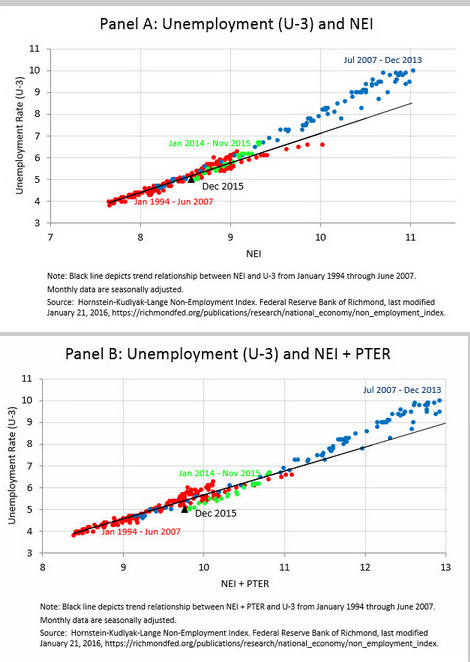
An additional version of the NEI is calculated to include people who are working part time but would like to work full time, a category called "part time for economic reasons" (NEI+PTER).
During the period prior to June 2007, there was a close linear relationship between the standard unemployment rate and the NEI. …