


Courtesy of Pam Martens.
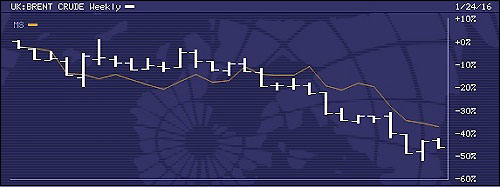
Morgan Stanley Price Chart (Yellow) Versus Brent Crude Oil (White) Since July 2015
By Pam Martens and Russ Martens: January 28, 2016
Yesterday, the U.S. Treasury’s Office of Financial Research (OFR) released its 2015 Annual Report to Congress. OFR was created under the Dodd-Frank financial reform legislation of 2010 to keep the Financial Stability Oversight Council informed on emerging threats to financial stability in the U.S.
Perhaps in an effort not to panic our sleeping Congress, or to further aggravate an already volatile stock market, the report said that “the United States financial system has continued to improve and threats to overall U.S. financial stability remain moderate.” From there, it went on to eviscerate that calm assessment with an endless stream of hair-raising concerns. One of those concerns is the interconnectedness of big Wall Street banks – a matter the OFR released a detailed paper on last February.
One fact you won’t find in the OFR report is that five of the biggest banks on Wall Street, which are also interconnected with one another, have seen their market capitalizations melt away like snow cones in July. Citigroup, Bank of America, JPMorgan Chase, Morgan Stanley and Goldman Sachs have cumulatively lost a total of $219.7 billion in market cap over the past seven months. All of the stocks are trading near their 12 month lows.
The declines in market cap stack up as follows: Citigroup, down $60.74 billion; Bank of America, down $53.3 billion; JPMorgan Chase, down $47.7 billion; Morgan Stanley, down $30.3 billion; and Goldman Sachs, a decline of $27.7 billion.
…

