


Courtesy of Pam Martens.
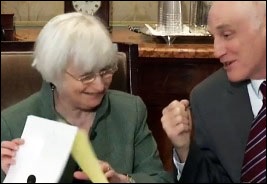
Fed Chair Janet Yellen Shares a Moment of Humor With Fed Board Member Daniel Tarullo Prior to the Open Board Meeting on March 4, 2016 Where the Fed Proposes a New Rule to Contain Counterparty Risk on Wall Street
Four days after the Federal Reserve Board of Governors held an open meeting to propose a new rule to contain counterparty risk on Wall Street on a bank by bank basis, researchers at the U.S. Treasury’s Office of Financial Research (OFR) dropped a bombshell on the Fed. The researchers, Jill Cetina, Mark Paddrik, and Sriram Rajan, produced a study which shows, in their opinion, that the Fed’s stress test that measures counterparty risk on a bank by bank basis is all wet. The problem, say the researchers, is not what would happen if the largest counterparty to a specific bank failed but what would happen if that counterparty happened to be the counterparty to other systemically important Wall Street banks.
The researchers note that the Fed’s stress test “looks exclusively at the direct loss concentration risk, and does not consider the ramifications of indirect losses that may come through a shared counterparty, who is systemically important.” By focusing on “bank-level solvency” instead of the system as a whole, the Fed may be ignoring the real problem of systemic risks in the system. The researchers write:
“A BHC [bank holding company] may be able to manage the failure of its largest counterparty when other BHCs do not concurrently realize losses from the same counterparty’s failure. However, when a shared counterparty fails, banks may experience additional stress. The financial system is much more concentrated to (and firms’ risk management is less prepared for) the failure of the system’s largest counterparty. Thus, the impact of a material counterparty’s failure could affect the core banking system in a manner that CCAR [one of the Fed’s stress tests] may not fully capture.” [Italic emphasis added.]
To put some simple language perspective on this, what Wall Street effectively did in the lead up to the crash of 2008, was to make the big insurer, AIG, its bitch. Some of the biggest Wall Street banks, like Goldman Sachs, Citigroup, and Merrill Lynch, got AIG to sell them credit default swaps. The swaps were a wager that if a financial institution, like Lehman Brothers, should fail, the Wall Street banks would collect billions of dollars from AIG. When Lehman failed, AIG didn’t have the money to cover the bets so a gun was put to the head of the taxpayer to make these Wall Street banks whole – at the outrageous rate of 100 cents on the dollar.
AIG turned out to be not so much a real counterparty to contain risk on Wall Street but a wager on how much fleecing of the U.S. taxpayer Congress would allow to cover gambling debts on Wall Street. The answer to that turned out to be an open spigot of money.
…

