


Courtesy of Pam Martens.
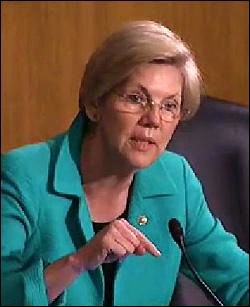
Senator Elizabeth Warren
The Wall Street Journal reported yesterday that two Federal regulators, the Federal Reserve and the Federal Deposit Insurance Corporation (FDIC), are set to “reject” the living wills of potentially four systemically important banks, including the largest bank in the U.S., JPMorgan Chase. The three other banks named are Bank of New York Mellon, State Street and Bank of America.
Under Section 165 of the financial reform legislation known as Dodd-Frank, banks designated as systemically important must submit living wills to the Fed and FDIC explaining how they can be “rapidly” liquidated if they fail without bringing down the rest of the financial system – as occurred in 2008.
A serious dust-up occurred on July 15, 2014 during a Senate Banking hearing between Senator Elizabeth Warren and Fed Chair Janet Yellen on the matter of these living wills. Warren told Yellen that at the time of its collapse in 2008, Lehman Brothers had $639 billion in assets and 209 subsidiaries and it took three years to unwind the bank in bankruptcy. Warren singled out JPMorgan Chase for comparison, saying that it has $2.5 trillion in assets and 3,391 subsidiaries.
Dodd-Frank specifically states that these wind-down plans must be “credible” each year or the Fed and FDIC must reject them and force the banks to take remedial steps such as simplifying their structure or selling off assets.
Yellen was clearly not prepared for this line of questioning and stumbled badly in her answers to Warren. She said the Fed was pursuing a “process,” that the plans are “complex” with some banks submitting plans that are “tens of thousands of pages.” Yellen then summed up with this:
“I think what was intended is this interpretation you’re talking about, whether they’re credible, in other words, do they facilitate an orderly resolution, and I think we need to give these firms feedback.”
…

