


Courtesy of Pam Martens.
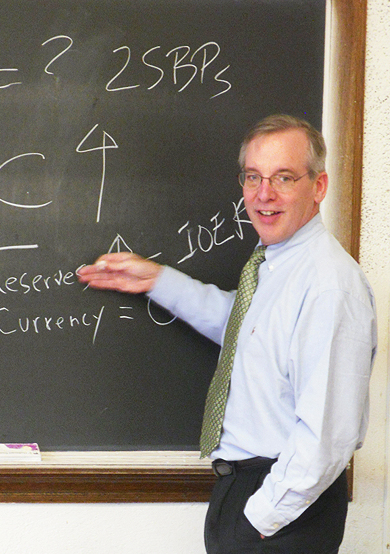
William C. (Bill) Dudley, President of the Federal Reserve Bank of New York
On May 1, William Dudley, the President of the New York Fed delivered a speech to the Atlanta Fed’s 2016 Financial Markets Conference. Dudley, who was previously hauled before Congress to examine his Wall Street cronyism, spent two-thirds of his talk meandering around the academic nuances of liquidity in a stressed market and then zeroed in for the kill. Dudley wants to extend the powers of the Federal Reserve as the lender of last resort beyond just banks to (wait for it) include broker-dealer stock trading operations. Under that scenario, Bernie Madoff’s market-making operation (that was also a fraud according to the Madoff Trustee Irving Picard) might have been borrowing from the Fed during the crisis of 2008. Maybe Madoff could have even borrowed enough from the Fed to still be operating.
Dudley’s exact words from the speech posted at the New York Fed’s web site were as follows:
“Now that all major securities firms in the U.S. are part of bank holding companies and are subject to enhanced prudential standards as well as capital and liquidity stress tests, providing these firms with access to the Discount Window might be worth exploring. To me, this is a more reasonable proposition now than it was prior to the crisis when the major dealers weren’t subject to those safeguards.”
Dudley’s push to further deform Wall Street is outrageous on multiple levels. First, it should be remembered that the strongest advocates of the public interest like Senators Elizabeth Warren and Bernie Sanders are pressing Congress to remove the safety net completely from securities firms by forcing them to be split off from banks holding insured deposits that are backstopped by the taxpayer. They want to restore the Glass-Steagall Act that protected this country for 66 years until its repeal in 1999. That legislation would completely bar stock-trading firms known as broker-dealers from being owned or affiliated with banks holding insured deposits.
Why is restoring the Glass-Steagall Act so clearly necessary today? In 2012, only through the curiosity of reporters at the Wall Street Journal and Bloomberg News was it revealed that JPMorgan Chase, the largest bank in the U.S., was using its insured deposits to make high risk gambles in exotic derivatives in London. The insured bank’s eventual losses were at least $6.2 billion. When the Senate’s Permanent Subcommittee on Investigations released its in-depth report on what became infamously known as the London Whale scandal, Senator Carl Levin who chaired the Subcommittee at the time said that JPMorgan Chase “piled on risk, hid losses, disregarded risk limits, manipulated risk models, dodged oversight, and misinformed the public.”
…

