


Courtesy of Pam Martens.
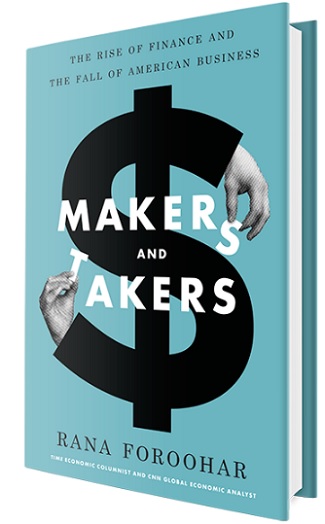
Rana Foroohar has written the equivalent of a public guide to why Americans remain mad as hell at Wall Street and Washington and why a lot worse than a political revolution may ensue if the plutocrats don’t wake up soon. Foroohar is an assistant managing editor at Time magazine and its economics columnist. In “Makers and Takers: The Rise of Finance and the Fall of American Business,” the author lays out a number of undeniable truths, which she backs up with footnotes and facts, such as: “the business of America isn’t business anymore.” That’s given way to financial engineering tricks like loading up a company’s balance sheet with billions of dollars of debt in order to prop up the share price with buybacks of the company’s own stock.
Foroohar, who has been a financial journalist for 23 years, correctly concludes that Wall Street has come to “rule” rather than to “fuel” the real economy. This has created a “dysfunctional financial system” that is doomed to another collapse, “taking us all down with it,” unless critical repairs are made soon. Foroohar maps out exactly what those repairs must be in her last chapter.
The author gives a litany of examples to show how “finance has transitioned from an industry that encourages healthy risk-taking, to one that simply creates debt and spreads unproductive risk in the market system as a whole.”
One case study Foroohar examines is the technology company, Apple, and its use of share buybacks built on borrowed money. Unfortunately, Apple is part of a mushrooming trend in such financial engineering. Foroohar writes:
“…Apple’s behavior is no aberration. Stock buybacks and dividend payments of the kind being made by Apple – moves that enrich mainly a firm’s top management and its largest shareholders but often stifle its capacity for innovation, depress job creation, and erode its competitive position over the longer haul – have become commonplace. The S&P 500 companies as a whole have spent more than $6 trillion on such payments between 2005 and 2014, bolstering share prices and the markets even as they were cutting jobs and investment.”
The flip slide of this financial trickery (she calls it “financialization’) says Foroohar is that “our economy limps along in a ‘recovery’ that is tremendously bifurcated. Wage growth is flat. Six out of the top ten fastest-growing job categories pay $15 an hour and workforce participation is as low as it’s been since the late 1970s. It used to be that as the fortunes of American companies improved, the fortunes of the average American rose, too. But now something has broken that relationship.”
…

