


Courtesy of Pam Martens.
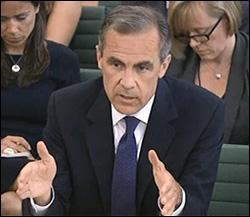
Mark Carney, BOE Governor, Testifying Before Parliament
If you think that a referendum vote on June 23 by UK citizens on whether to withdraw from the European Union (called Brexit, short for British Exit), is simply a proxy on whether the UK should dislodge itself from the edicts of Brussels, think again. It’s morphed into a much broader debate on whether citizens worldwide should surrender their right to a participatory democracy in order to further the interests of multinational corporations, secret trade agreements packed with secret court tribunals, global banking hegemony and central banks attempting to keep all these balls in the air for their one percent overlords.
One particular central bank is sure to come under fire today. Members of the British Parliament have been warning Mark Carney, head of the Bank of England (BOE), to not engage in political lobbying on the issue of Brexit, which he is perceived to have been doing for months. Carney is already the subject of skepticism in the U.K. He’s a former Goldman Sachs executive, former Governor of the Bank of Canada and the first foreigner to run the BOE in its 300-year history. (This is reminiscent to many of how Stanley Fischer, head of Israel’s central bank from May 2005 until the end of June 2013 and before that a Citigroup Vice Chairman who was born in Zambia, is now Vice Chairman of the U.S. central bank, the Federal Reserve.)
Continuity government at central banks, like continuity government in the Oval Office, helps to ensure the perpetuation of a positive unified message on globalization as the realities of an institutionalized wealth transfer system to the one percent comes into ever greater focus by those paying attention.
Carney appears to have spit in the eye of Parliament again today with the release of the BOE’s Monetary Policy Committee statement, which was filled with a litany of horrors on what could happen if the UK leaves the European Union. The statement said in part:
“In the weeks since the May Report, an increasing range of financial asset prices has become more sensitive to market perceptions of the likely outcome of the forthcoming EU referendum. On the evidence of the recent behaviour of the foreign exchange market, it appears increasingly likely that, were the UK to vote to leave the EU, sterling’s exchange rate would fall further, perhaps sharply. This would be consistent with changes to the fundamentals underpinning the exchange rate, including worsening terms of trade, lower productivity, and higher risk premia. In addition, UK short-term interest rates and measures of UK bank funding costs appear to have been materially influenced by opinion polls about the referendum. These effects have also become evident in non-sterling assets: market contacts attribute much of the deterioration in global risk sentiment to increasing uncertainty ahead of the referendum. The outcome of the referendum continues to be the largest immediate risk facing UK financial markets, and possibly also global financial markets.
…

