

Courtesy of Pam Martens.
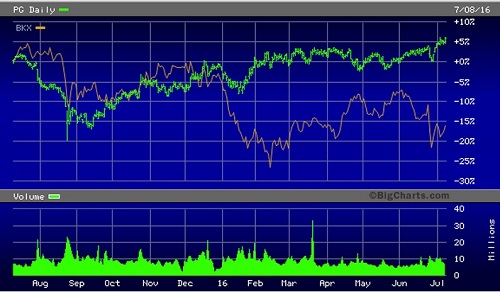
Procter and Gamble, a Consumer Staples Stock (Green Line), Versus KBW Bank Index, Stock Symbol: BKX (Orange Line), Over the Past 12 Months
By Pam Martens and Russ Martens: July 11, 2016
If it’s any comfort, and it likely won’t be, markets are now even more bizarre than the situation of the two presumptive candidates for the President of the United States: one is escaping indictment for treating above Top Secret material with the seriousness of a drunken frat boy at an all-night party while the other is hurling adolescent insults on his Twitter page. This in a country where the Commander in Chief will oversee more than 7,000 nuclear warheads.
On Friday, the Standard and Poor’s 500 Index traded intraday at a new high of 2131.71, beating its prior closing high of 2130.82. It closed a tad lower at 2129.9 but still up 1.53 percent on the day. A rally in the stock market would normally drain money from U.S. Treasury notes, since a stock rally means confidence in a growing economy while a rally in Treasury securities would normally suggest a flight to safety over fears of a weakening economy. But that didn’t happen Friday.
As the S&P 500 flirted with an all-time high, the 10-Year U.S. Treasury note also rallied in price, dropping its yield to a record low of 1.366 percent. To fully contemplate what a record low yield on the 10-year Treasury is suggesting, one needs to reflect on the fact that during the Civil War when the country was torn in half, the 10-year T-Note yielded above 5 percent; during the Great Depression, with over 20 percent unemployment and raging deflation, the 10-year T-Note yielded over 2 percent.
According to corporate media headlines, we are not in a Great Depression so why are we plumbing the depths of historic low yields? We won’t know what this era will be called until the history books are written many years from now, but we have a strong suspicion about what those history books will say. (We’ll get to that in a moment.)
…

