


Courtesy of Pam Martens
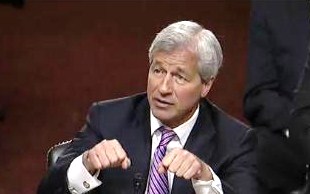
Jamie Dimon Testifying at a Senate Banking Hearing on June 13, 2012.
A mere three months after JPMorgan Chase and three of its competitors (Citicorp, Barclays and the Royal Bank of Scotland) pleaded guilty to a felony charge of conspiring to rig foreign currency trading and paid criminal fines totaling over $2.5 billion, the CEO of JPMorgan Chase, Jamie Dimon, began meeting in secret with his competitors in the asset management field.
On February 1 of this year, the Financial Times reported that “secret summits” had been held beginning in August 2015 between “asset management bosses” including Jamie Dimon, Abby Johnson of Fidelity, Larry Fink of BlackRock, and Tim Armour of Capital Group. The article went on to report that Dimon and Warren Buffett had convened the sessions at JPMorgan’s headquarters in New York to discuss “a statement of best practice on corporate governance.”
Secret meetings between competitors, regardless of what they are said to be discussing, is a serious no-no under U.S. antitrust law. A company like JPMorgan Chase, that was charged by the U.S. Justice Department in 2014 with two deferred prosecution felony counts for its egregious conduct in the Bernie Madoff Ponzi scheme and hit again the next year with the felony count in the foreign currency conspiracy is skating on very thin ice. (It should be noted that under Jamie Dimon’s leadership, JPMorgan Chase received its only felony counts in the bank’s century old history. That should tell the public something about how things have changed in American banking culture.)
Two trial lawyers, Helen Davis Chaitman and Lance Gotthoffer, have written a book and set up a web site to call the public’s attention to JPMorgan’s mob-like activity. The lawyers write: “In the past four years alone, JPMorgan Chase has paid out $35,735,254,670 in fines and settlements for fraudulent and illegal practices.” In one chapter of the book, they compare JPMorgan Chase to the Gambino crime family and recommend that it be prosecuted under the Racketeer Influenced and Corrupt Organizations Act (RICO).
If these meetings were genuinely about crafting “best practice on corporate governance” why did they commence in secret? Why were they not commenced at one of the official financial industry trade associations like the Financial Services Forum or the Securities Industry and Financial Markets Association (SIFMA), which says it is “the voice of the nation’s securities industry.”
…

