


Courtesy of Pam Martens.
By Pam Martens and Russ Martens: September 14, 2016
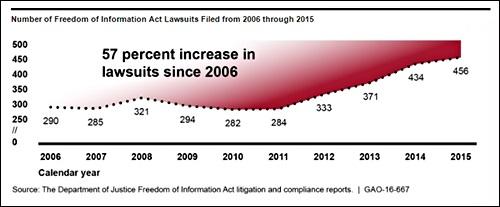
Last Thursday the Government Accountability Office (GAO) released a report showing that since President George W. Bush left office, lawsuits by persons who were unable to obtain Federal records that they believed belonged in the public domain grew dramatically. In 2008, the last year of Bush’s presidency, 321 Freedom of Information Act (FOIA) lawsuits were filed. By 2014, that number had spiked to 434 lawsuits and registered 456 last year, an increase of 42 percent over 2008.
The numbers understate the public’s frustration with Federal government stonewalling on public record requests. According to the GAO report, 713,168 FOIA requests were made by the public last year. Before one can file a FOIA lawsuit, one must file an administrative appeal with the agency that denied or partially denied the records sought. Average citizens have inadequate time and resources to engage in fighting an entrenched, stonewalling bureaucracy.
Curiously, the GAO study wasn’t looking at whether the public interest was being served under the FOIA legislation; it was looking at costs to the Federal government for stonewalling and getting sued. Its finding, in a nutshell, is that it’s quite cost effective to draw a dark curtain around the U.S. government. The report found that for fiscal years 2009 through 2014, Federal agencies “collectively reported costs totaling $144 million for all of the FOIA lawsuits that they defended.” Out of an approximate $3.5 trillion in Federal expenditures in 2014, $144 million is likely pocket change in the government’s view.
Fighting your government in Federal court, where FOIA lawsuits land, is not a particularly winning strategy either. The GAO study found that of the “1,672 Freedom of Information Act (FOIA) lawsuits with a decision rendered between 2009 and 2014, GAO identified 112 lawsuits where the plaintiff substantially prevailed” in court. Federal courts have judges who are appointed by the President of the United States and have lifetime appointments, making them free from worry about losing their job because of a public uprising over jaded decisions.
…

