


Courtesy of Pam Martens.
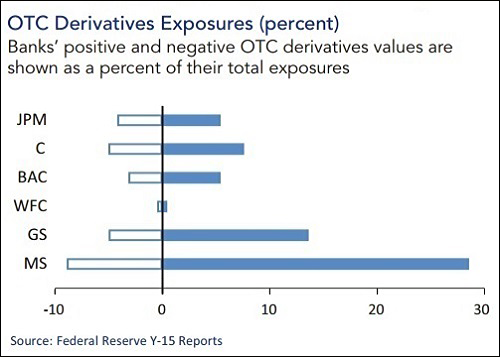
OFR Data Shows Derivative Exposures as Percent of Total Exposures (Symbols: JPM= JPMorgan Chase; C=Citigroup; BAC=Bank of America; WFC=Wells Fargo; GS=Goldman Sachs; MS=Morgan Stanley)
By Pam Martens and Russ Martens: September 30, 2016
One day after Federal Reserve Chair Janet Yellen failed to reassure the House Financial Services Committee that too-big-to-fail banks no longer pose a threat to the U.S. financial system, the stock market settled the debate. Germany’s largest bank had a dizzy spell and Wall Street banks swooned under a collective anxiety attack.
The writing has been on the wall for a very long time that this scenario was going to eventually play out given the lack of serious reform of Wall Street. What was notable about yesterday’s market activity is that among the major Wall Street banks, Goldman Sachs fared worst, falling 2.75 percent, followed by Morgan Stanley which shed 2.30 percent and Citigroup, which lost 2.28 percent.
All of the major Wall Street banks were dragged down by the 6.67 percent decline in the shares of Deutsche Bank by the close of trading on Thursday on the New York Stock Exchange. Since last October, Deutsche Bank shares have lost 62 percent of their market value, leaving the bank with a common equity market value of $15.8 billion to anchor assets of $1.9 trillion. (See Is Deutsche Bank as Dangerous to Financial Stability as Citigroup Was in 2008.)
Why Goldman Sachs, Morgan Stanley and Citigroup shed more equity value than Wall Street banks with much larger balance sheets like JPMorgan Chase and Bank of America was foretold on February 12, 2015 when the research agency created under the Dodd-Frank financial reform legislation issued a report with the above troubling graph. The report from the Office of Financial Research (OFR) was titled Systemic Importance Indicators for 33 U.S. Bank Holding Companies: An Overview of Recent Data. The above graphed data from the report indicates that Morgan Stanley, Goldman Sachs and Citigroup had the highest OTC derivatives values as a percent of their total exposures.
…

