


Courtesy of Pam Martens.
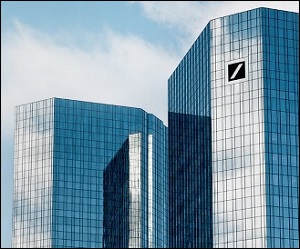
Deutsche Bank Headquarters in Frankfurt, Germany
The gyrations in Deutsche Bank’s shares last week together with a June report from the International Monetary Fund indicating that the bank was “the most important net contributor to systemic risks” has cast a trading pall over all of the global banks.
Against that backdrop, most Americans would be stunned to learn that the German Deutsche Bank, which perpetually finds itself on the wrong side of the law, was bailed out in five separate U.S. emergency lending operations during the 2007-2010 financial crisis, receiving more than twice the emergency financial assistance as that received by Lehman Brothers, the failed U.S. investment bank.
According to the Government Accountability Office (GAO), Deutsche Bank received cumulative loans totaling $77 billion under the Federal Reserve’s Primary Dealer Credit Facility (PDCF) and $277 billion in cumulative loans under the Term Securities Lending Facility (TSLF) for a total of $354 billion. Lehman Brothers received only $183 billion in Fed emergency lending programs according to the GAO report. (See GAO chart below.) These loans were made at below-market interest rates, thus constituting a bailout.
As Senator Elizabeth Warren explained to her colleagues on the Senate Banking Committee on March 3 of last year:
“Now, let’s be clear, those Fed loans were a bailout too. Nearly all the money went to too-big-to-fail institutions…Those loans were made available at rock bottom interest rates – in many cases under 1 percent. And the loans could be continuously rolled over so they were effectively available for an average of about two years.”
…

