


Courtesy of Pam Martens.
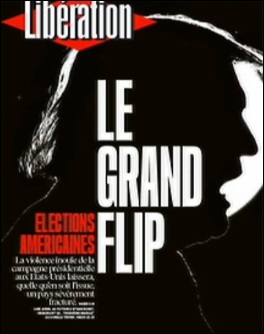
As election day arrived in the U.S. yesterday, European newspapers signaled their grave concerns over a presidential election that has left them stunned and anxious. The French newspaper, Aujourd’hui En France, used its front page to question whether the American dream (Le Reve) even still exists in the U.S. The French Liberation publication featured a silhouette of Donald Trump’s face on its front cover with the prophetic bold headline, “Le Grande Flip.”
The day before the election, Jonathan Freedland wrote in the U.K.’s Guardian newspaper:
“…one thing will certainly be over – and that is the dizzying, sometimes nauseating, 18-month-long saga that has been the 2016 campaign….In 2012, the Guardian’s front-page story branded the battle of Barack Obama v Mitt Romney ‘one of the most closely fought and polarised in recent history’. Looking back, that race looks like a veritable philosophy seminar, exemplary in its civility and decorum, compared with this one.”
Arthur Goldhammer had thoughts about Tocqueville and Davy Crockett in Le Monde Diplomatique:
“ ‘A presidential election in the United States may be looked upon as a time of national crisis,’ Tocqueville wrote. ‘As the election draws near, intrigues intensify, and agitation increases and spreads. The citizens divide into several camps, each behind its candidate. A fever grips the entire nation. The election becomes the daily grist of the public papers, the subject of private conversations, the aim of all activity, the object of all thought, the sole interest of the moment.’
“To be sure, for all his prescience, the French visitor could hardly have foreseen the unique ‘agitation’ of the 2016 presidential election, although he was under no illusion that popular sovereignty posed any sort of bar to the election of the uncouth and uncultivated. After all, the voters of one congressional district had sent to the House of Representatives ‘a man with no education, who can barely read [and] lives in the woods.’ (The man was frontiersman and folk hero Davy Crockett.) Nor was Tocqueville unfamiliar with the pretensions of wealthy New Yorkers who resided in ‘marble palaces’ that turned out, on closer inspection, to be made of ‘whitewashed brick’ with ‘columns of painted wood’. Hence, neither the ersatz splendour of Trump Tower nor its principal inhabitant’s unfamiliarity with the US constitution or the Russian occupation of Crimea would have surprised him, although Donald Trump’s nomination as the presidential candidate of a major political party would surely have shocked him even more than Crockett’s election to Congress. A democratic people might not always choose its leaders wisely, but the quality of its choices would surely improve, Tocqueville believed, as education was democratised and ‘enlightenment’ spread. Perhaps he was too optimistic.”
…

