


Grim Reaping
Courtesy of George Monbiot
Brexit could wreck the British countryside – or it could save it. It depends on getting our voices heard.
 By George Monbiot, published in the Guardian 11th January 2017. Of course farmers fear Brexit, but it could save the British countryside.
We will leave the European Union like a drunk tumbling out of a pub at closing time, perhaps with the barman’s boot on our backside. We’ll find ourselves face down on the pavement wondering what just happened. The idea of an orderly, negotiated exit retreats to the margins of possibility: the more likely outcome is chaotic rupture.
No industry will be kicked harder by Brexit than farming. It is uniquely vulnerable for three reasons. Small changes to the amount of goods allowed to enter this country with low trade taxes (a system known as tariff rate quotas) could knock many farmers out of business. There are 86 agricultural products subject to these quotas in the EU, and the UK might have to renegotiate every one of them, in some cases with dozens of other nations. The complexity could be overwhelming.
Without labourers from the EU, fruit and vegetable growers will not get their crops off the fields. As a result of perceived hostility and a weaker pound, migrant farm labour fell by 30% after the referendum last year. If the government ends free movement, many producers will go under.
Most importantly, farmers here have developed a toxic dependency on European subsidies. These now provide, in aggregate, over half their income. It is hard to see how the government could keep paying them in their current form.
Every year, €50 billion is taken from the pockets of European taxpayers of all stations, and poured disproportionately into the pockets of the very rich. The money is paid by the hectare, so the more land you own, the more cash you are given. In England, the government has refused to limit the money a landowner can receive: some people receive hundreds of thousands of pounds a year in public funds. Social security is capped only for the poor.
Nor are these funds reserved for farming. The government uses this system to keep its members and friends in the style to which they feel entitled. Some of them claim this money for land used to breed racehorses and shoot grouse. David Cameron’s government raised the public subsidy for grouse moors by 86%.
But that’s not the worst of it. To claim most farm subsidies, you must keep the land bare: the system amounts to a €50-billion perverse incentive for clearing wildlife habitats. Across the European Union, hundreds of thousands of hectares of woods, scrubland, reedbeds, ponds and other “ineligible features” have been destroyed for the sole purpose of claiming public money.
The subsidy system sustains the greatest cause of habitat and wildlife destruction in Britain (whose impacts are far wider than all the building that has ever taken place here): sheep grazing on infertile land. Sheep have not so much altered the ecosystem as removed it altogether, stripping most edible plants and much of the soil from the land, leaving nothing of what would once have been a rich mosaic of forest and glade except coarse grass, occasionally interspersed with bracken and bare rock: the only things they can’t eat.
There are no official figures for the amount of land used by sheep in this country, so I commissioned some research of my own. The results are very rough and provisional; a full survey would take many months and cost quite a few thousand pounds. But they are of this order. The area grazed by sheep in Britain is broadly equivalent to our entire arable acreage. In other words, sheep occupy roughly the same amount of land as is used to grow all the cereals, oilseeds, potatoes, fruit, vegetables and other crops this country produces. Yet lamb and mutton provide just 1.2% of our diet. Nor are they feeding the rest of the world – imports and exports of sheepmeat are almost exactly matched. (I explain how these figures are derived on my website).
In other words, this is an astonishingly profligate use of land. It is hard to think of any industry, anywhere on earth, with a higher ratio of destruction to production. Because it is uneconomic, it depends entirely on European money. It should be a source of enduring shame to Britain’s big conservation groups that, out of sheer cowardice, they refuse to confront this pointless mass erasure of wildlife at public expense.
This spending – £3 billion a year in the UK, which is roughly equivalent to the NHS deficit – has been protected only by the fact that our government is not directly responsible for it. As soon as the money appears on national accounts, it will become politically unsustainable. The system has to change. We should ensure it changes for the better.
New Zealand shows how not to do it. When subsidies were suddenly stopped there in 1984, small and medium-sized farms went under, and the government protected the remaining producers by scrapping environmental laws. It would not be surprising to see this happen here. European measures protecting the natural world, such as the habitats and birds directives, are likely to become zombie legislation in the UK after Brexit, as the institutions required to enforce them will no longer exist. With Andrea Leadsom in charge of farming and Liam Fox in charge of trade, everything could go. Both farmers and conservationists should fiercely resist these outcomes.
The only fair way of resolving this incipient crisis is to continue to provide public money, but only for the delivery of public goods, such as restoring ecosystems, preventing flooding downstream and bringing children and adults back into contact with the living world. This should be accompanied by rules strong enough to ensure that farmers can no longer pollute our rivers, strip the soil from the land, wipe out pollinators and other wildlife and destroy the features of the countryside with impunity.
If farmers are to be exposed to market forces, the market should be fair. This means curtailing the power of the chainstores, and, where necessary, breaking them up: it is outrageous that farmers receive only 9% of the value of their produce sold in supermarkets.
None of this will be easy; but we could pluck from the wreckage a better system of support for farmers and the countryside than exists at the moment. It would be hard to think of a worse one.
****
Explanation of the Figures in Grim Reaping
This explains how the rough estimates of the area occupied by sheep in the UK were derived.
By George Monbiot, published on monbiot.com, 11th January 2017.
The total average consumption of lamb and mutton in the UK, both in and out of the home, is, according to the Agriculture and Horticulture Development Board, 5.0kg per person per year.
100g of lamb contains approximately 294kcal.
So approximate annual average calorie intake from lamb is 14,700kcal. Annual average total calorie intake per person in the UK is approximately 1,250,000 kcal. Therefore lamb provides roughly 1.18% of our calories.
Imports and exports are almost exactly balanced.
The UK’s total cropped area is easy to come by. It is given by the government as 4,722,000 hectares. But there are no comparable figures for sheep grazing.
Please note that the following gives very rough estimates/guesstimates of the area occupied by sheep grazing. It is remarkable that neither official nor academic figures are obtainable; it would be good to see this omission rectified.
We have approached the problem in two ways. The first was to obtain an estimate for the total upland area of the United Kingdom, then, as sheep grazing is the default land use almost everywhere, subtract from this area the other major land uses: deer stalking, grouse shooting and forestry. This tilts it towards a likely overestimate on one hand (some parts of the uplands are used for cattle or mixed cattle and sheep, and there are areas, such as bare rock, that sheep cannot graze) and a likely underestimate on the other (not all the land occupied by sheep is in the uplands, and sheep also graze on some of the land used for deer stalking and infest many woods from which they are meant to be excluded). This produced the following very tentative results:
Upland area of the UK (summing the figures provided by email by the devolved administrations /governments): 7,750,000 ha
Industry estimates for deer stalking estates: 1,830,000 ha.
Industry estimates for grouse moors in England, Scotland and Wales: 1,344,000 ha
Upland forestry/woodland: no figures available. I have used a very rough guess, going by satellite images, of 5%, giving 390,000 ha.
Total left for grazing: 4,186,000.
The second approach was to throw together all the sources of relevant information we could find, and use rough rules of thumb to try to make sense of it.
In England, according to the government, there are 997,780 ha of land in commercial farms in severely disadvantaged areas (SDAs). SDAs means uplands and other areas of very infertile land. Of these, 89% (roughly 890,000 ha) is used for commercial farming. 435,000 are occupied by sheep and 252,000 by mixed sheep and beef. If we were to allocate 50% of the mixed sheep and beef area to sheep, this gives sheep a total of 561,000 hectares, or 63% of the area in commercial farms.
NB: these figures exclude common land, which covers large areas of the uplands in England, and is likely to be dominated by sheep.
There is no comparable breakdown for Wales. But the UK National Ecosystem Assessment states that agricultural land occupies 1,640,000 ha, of which arable land accounts for 162,000 ha, suggesting that livestock occupies the rest: 1,478,000 ha. If we were to assume the same distribution of livestock to that in the English SDAs, this would give 930,000 hectares of land occupied by sheep there.
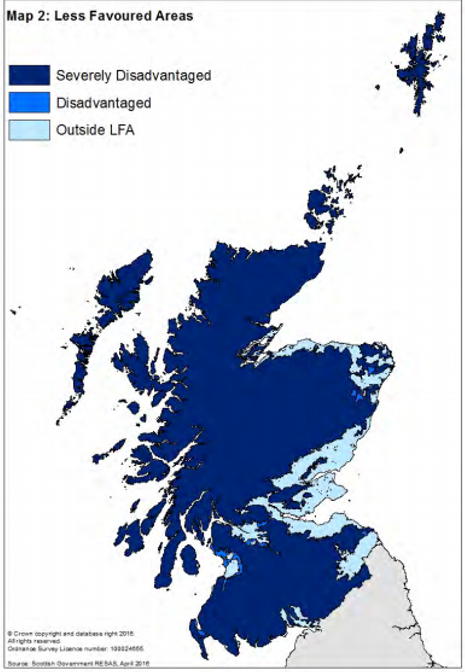
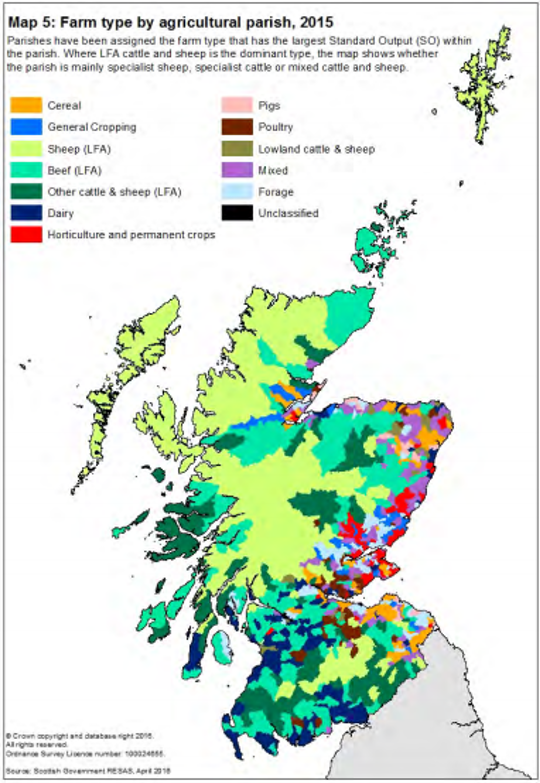
A bar chart in a report by the Scottish government from 2010 suggests that rough grazing occupies approximately 4m ha of that nation and grassland standing for 5 years or longer approximately 1m ha, in other words 5m ha in total. If we were to apply the ratio derived from the English survey, this would give a total of 3.1m hectares to sheep. The following maps, published in the Economic Report on Scottish Agriculture, 2016, suggests that this proportion is in the right ballpark:
Severely disadvantaged areas (dark blue):
Area occupied by sheep (light green) and mixed sheep and beef (dark green):
In Northern Ireland, there are 451,445 ha of agricultural land in severely disadvantaged areas, according to figures compiled by the RSPB. Applying the English proportion of 63% would give 280,000 ha under sheep.
So this extremely rough estimate provides us with the following, extremely rough figures:
England: 560,000
Wales: 930,000
Scotland: 3,100,000
Northern Ireland: 280,000
Total: 4,870,000
Let’s round this down, to reduce the likelihood of exaggeration. Any improvements on 4,000,000 hectares?

