


Courtesy of Pam Martens
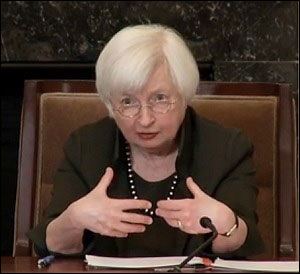
Fed Chair Janet Yellen Addressing Teachers on January 12, 2017
Last night the Federal Reserve convened a Town Hall meeting via webcast with K-12 teachers and college educators of economics and history. Federal Reserve Chair Janet Yellen delivered a speech and then took a series of questions from teachers. It was during the Q&A period that Yellen gave a sobering assessment of the long-term prospects for the U.S. At numerous points, Yellen echoed the income inequality themes that Senator Bernie Sanders raised repeatedly at his rallies around the country during the presidential primaries.
When asked about the biggest obstacles to the U.S. economy over the short and long term, Yellen said she did not have serious concerns over the short term but was worried about the longer term. In addition to productivity concerns, Yellen stated: (See video clip below.)
“We have seen over many decades now that the returns – the wages and income – of people with more education and higher skills have continued to increase systematically relative to those with less education. By some measures, men with a high school education or less are seeing not only stagnant incomes but the disappearance of jobs that afforded them reasonably secure lives and retirements. And these are problems that really lie outside the scope of what the Federal Reserve is able to address and I think they represent longer term structural trends in the global economy.”
In a similar vein, Yellen remarked:
“I also worry a great deal about inequality and the fact that the largest share of gains from aggregate productivity growth have gone to workers at the top of the income distribution. And the gap we’re seeing, as I mentioned, between wages of those with a college education and high school or less have just continued to increase. I mean you can look at some measures that suggest that real wages of high school educated workers have essentially been stagnant for several decades and there’s some recent research that shows that a far smaller share of young people – if you think about the American Dream, that people expect their children to do better than they did, for generations to progress – a far smaller share of young people today are doing as well or better than their parents than was true for most of the post war period.”
…

