

Courtesy of Pam Martens
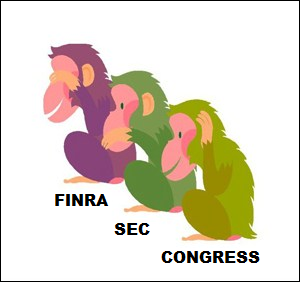
Increasingly, under the mantra of liquidity, trading activity on Wall Street that would have resulted in criminal charges in another era is yawned at by regulators.
The week that Donald Trump shocked markets around the globe by getting himself elected President of the United States, Wall Street banks like Citigroup, JPMorgan Chase, Bank of America and others traded millions of shares of each other’s stocks – as well as trading millions of shares of their own publicly traded stock.
The trades were not directed to a regulated stock exchange like the New York Stock Exchange. Instead, the trades were conducted internally by the Wall Street bank’s own Dark Pool – an entity appropriately named for its darkness and hands-off regulation.
In an effort to create the illusion that there is some element of transparency about what is going on in these Dark Pools, Wall Street’s self-regulator, FINRA, began reporting three-week old trading data to the public on June 2, 2014. That’s when Wall Street On Parade first made the stunning discovery that the banks were trading in their own company stock. (See related articles below.)
According to the FINRA data, for the week of November 7, 2016 (which included the Tuesday Presidential election in the U.S.) Dark Pools traded 158.8 million shares of Bank of America’s stock. That was more than three times the number of shares traded the prior week in Bank of America shares by Dark Pools. Of the 158.8 million shares traded, 1.2 million shares were traded in 6,850 separate trades by an internal Dark Pool at Bank of America’s Merrill Lynch unit called Instinct X.
The same week, one of Citigroup’s myriad Dark Pools, Citi Cross, traded 360,924 shares in 2,026 separate trades in its own stock.
…

