


Courtesy of Pam Martens.
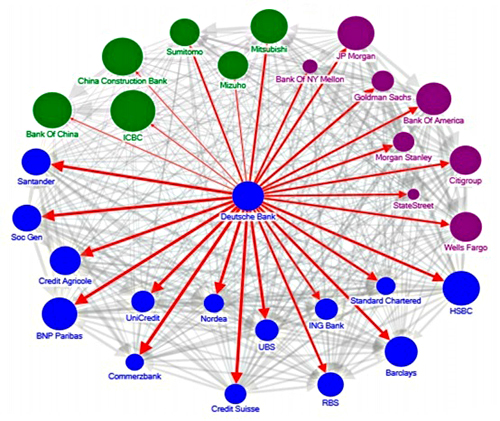
Systemic Risk Among Deutsche Bank and Global Systemically Important Banks (Source: IMF — “The blue, purple and green nodes denote European, US and Asian banks, respectively. The thickness of the arrows capture total linkages (both inward and outward), and the arrow captures the direction of net spillover. The size of the nodes reflects asset size.”)
By Pam Martens and Russ Martens: March 7, 2017
Yesterday, the German global bank, Deutsche Bank, fell by 3.82 percent by the close of trading on the New York Stock Exchange on news of a capital raising and revamp in strategy. That price action took down every major Wall Street bank stock and, interestingly, MetLife, which closed down 1.64 percent, beating out even Citigroup which closed down 1.18 percent. The rest of the major derivatives players fared as follows: JPMorgan Chase closed with a loss of 0.95 percent; Bank of America was off by 0.75 percent; Morgan Stanley closed down 0.56 percent; with Goldman Sachs down a meager 0.35 percent after infusing itself throughout the Trump administration’s corridors of power in Washington.
Last June, Deutsche Bank found itself the subject of unwanted attention in a report issued by the International Monetary Fund (IMF). The report looked at the “Financial System Stability” of German financial institutions and examined the systemic impact that a major bank blowing up would have on other domestic German banks and insurers as well as financial stability in other countries. The report concluded that spillover effects would not be limited to Germany but would impact France, the U.K. and the U.S.
The troubling report called out Deutsche Bank as “the most important net contributor to systemic risks.” (See chart above.) Its findings included the following:
“Notwithstanding moderate cross-border exposures on aggregate, the banking sector is a potential source of outward spillovers. Network analysis suggests a higher degree of outward spillovers from the German banking sector than inward spillovers. In particular, Germany, France, the U.K. and the U.S. have the highest degree of outward spillovers as measured by the average percentage of capital loss of other banking systems due to banking sector shock in the source country…
…

