

Courtesy of Pam Martens.
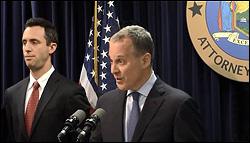
New York State Attorney General Eric Schneiderman (at Microphone)
At last we know why the New York State Attorney General’s office has decided to sideline the Securities and Exchange Commission and U.S. Department of Justice and become the self-appointed watchdog over Wall Street’s Dark Pools: it’s helping its hometown industry by doling out tiny fines and never digging too deep. This past Friday’s fine against Merrill Lynch’s Dark Pool marks the fourth time since 2014 that the office of New York State Attorney General Eric Schneiderman has leveled a meaningless fine of less than $50 million against the Dark Pools of Wall Street’s mega banks that are making billions of dollars in profits each year through what Senator Bernie Sanders calls a “business model of fraud.” (Schneiderman’s office brought earlier charges against Barclays, Credit Suisse and Deutsche Bank.)
On Friday, Schneiderman’s office issued a press release on its $42 million fine against Bank of America’s Merrill Lynch subsidiary for an insidious fraud that Merrill had internally called “masking.” The press release itself, however, masked the brazenness and seriousness of what Merrill Lynch had done. By reading the actual settlement agreement instead of the detail-lacking press release, we added up the following crimes that Merrill Lynch had committed versus the puny fine of $42 million:
The company had falsified internal documents it provided to customers for at least five years in commission of a crime; it falsified reporting data on where stock trades were actually executed for its customers; it engaged in secretly routing orders to Bernie Madoff’s market-making business, which was itself being financed by Madoff’s massive Ponzi scheme, raising the possibility that it helped to make it appear legitimate; it falsified invoices to customers, lying about where their trades had been executed; and it altered its internal technology to facilitate placing false information on customer invoices. The settlement document explains:
“Beginning in March 2008, BofAML [Bank of America Merrill Lynch] entered into agreements with ‘electronic liquidity providers’ (‘ELPs’) to execute a portion of BofAML’s institutional client orders. Those ELPs, which changed over time, included Citadel Securities, D.E. Shaw, Madoff Securities, Knight Capital, Getco (which later merged with Knight Capital to become KCG, now owned by Virtu Financial), Two Sigma Securities, Sun Trading, and ATD (then a division of Citigroup, now owned by Citadel Securities)…Pursuant to the agreements, the ELPs could choose whether to fill the DSA orders themselves. In return, the ELPs did not charge BofAML for the executions. The prices at which those trades executed with the ELPs were, in industry parlance, at the ‘far side’ of the spread between the bid and the ask.”
What was really going on here? Schneiderman says in his press release that Merrill Lynch was using its “technology to exploit their clients in service of their business relationships with large industry players.” Translation: making big loans to hedge funds and high frequency traders (prime brokerage) is a very profitable business and wooing those “large industry players” is apparently worth the gamble of running afoul of the law.
…

