


Courtesy of Pam Martens
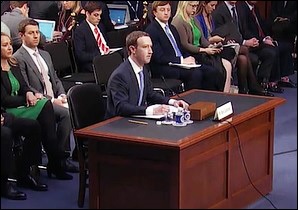
Facebook CEO Mark Zuckerberg Testifies Before Congress on April 10, 2018 on His Company’s Technology Failings
Remember the late 90s when the Masters of the Universe on Wall Street were bringing to market anything that smelled of technology or had a dot com after its name. That all ended badly with the Nasdaq stock index losing 78 percent of its value from 2000 to 2002. This is how Ron Chernow correctly described what was happening for New York Times’ readers on March 15, 2001:
“Let us be clear about the magnitude of the Nasdaq collapse. The tumble has been so steep and so bloody — close to $4 trillion in market value erased in one year — that it amounts to nearly four times the carnage recorded in the October 1987 crash.”
Chernow characterized the Nasdaq stock market as a “lunatic control tower that directed most incoming planes to a bustling, congested airport known as the New Economy while another, depressed airport, the Old Economy, stagnated with empty runways. The market functioned as a vast, erratic mechanism for misallocating capital across America,” Chernow observed.
Let that sink in for a moment. It wasn’t just that investment bankers on Wall Street were bringing to the public markets companies with the equivalent of a business plan written on the back of a napkin. It was that all of the major investment banks on Wall Street, out of a motive of pure greed, were engaged in a mass conspiracy to misallocate capital across America – which strikes at the very heart of America’s economy and national interests.
In 2003 the SEC charged Credit Suisse First Boston, Merrill Lynch and Salomon Smith Barney with issuing “fraudulent research reports” on tech companies and charged Bear Stearns, Goldman Sachs, Lehman Brothers, Piper Jaffray and UBS with issuing research reports that “contained exaggerated or unwarranted claims.”
…

