

Courtesy of Pam Martens
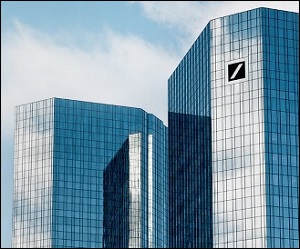
Deutsche Bank Headquarters in Frankfurt, Germany
Spasms in big Wall Street bank stocks have been happening on a serial basis over the past three years. (See here and here.) Yesterday offered another one of those bank warning signs to a Congress intent on further deregulation of an already dangerously deregulated market.
As the stock market grappled yesterday with fears of sinking emerging market currencies leading to loan defaults at European banks that are derivative counterparties to the biggest banks on Wall Street, the Wall Street banking sector was a sea of red. Two banks in particular sold off more than others.
Deutsche Bank is the big German lender that trades on the New York Stock Exchange. It closed with a loss of 2.61 percent versus a much milder decline of 0.76 percent in the Standard and Poor’s 500 Index. Posting a final trade of $11.19, Deutsche Bank closed at just 83 cents above its all time closing low of $10.36 which came in late June. This leaves Deutsche Bank with a scant $23.1 billion in equity market value to support a notional (face amount) derivatives book of 48 trillion euros or roughly 54.6 trillion U.S. dollars. Deutsche Bank has lost 75 percent of its market value over the past five years while it has continued to remain heavily engaged as a counterparty to global bank derivative trades.
In 2016 the International Monetary Fund (IMF) issued a report that set off alarm bells about the potential for systemic banking contagion to emanate from Deutsche Bank as a result of its counterparty exposures. The report provided a graphic (see below) that demonstrated that problems at Deutsche could spill over onto such big Wall Street banks as Morgan Stanley, JPMorgan Chase, Citigroup, Bank of America and Goldman Sachs. Those five banks just happen to be where derivatives are deeply concentrated in the U.S.
Deutsche Bank’s 2017 Annual Report contains additional cause for alarm. It shows that 28 percent of Deutsche Bank’s €48 trillion derivatives book is not being centrally cleared but is simply bilateral contracts between it and another party. (That represents approximately 15.28 trillion U.S. dollars for a bank with $23.1 billion in equity capital.) That means that Deutsche Bank and whomever is on the other side of those derivatives trades are on the hook to each other for any losses, as opposed to a central clearing party (CCP) backing the trade. The lack of central clearing parties for derivative trades is why the big life insurer AIG required a $185 billion backstop from the U.S. taxpayer to prevent it from defaulting on its massive credit default derivative trades with Wall Street and global banks during the 2008-2009 financial crisis. It is also why Lehman Brothers imploded in short order in the 2008 Wall Street crash.
…

