


Courtesy of Pam Martens
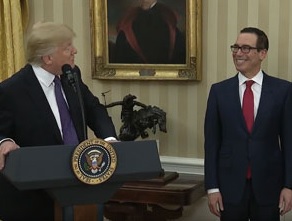
Steven Mnuchin Is Sworn In as U.S. Treasury Secretary by Donald Trump on February 13, 2017
On Sunday, December 23, 2018, the sitting U.S. Treasury Secretary, Steve Mnuchin, lit up the airwaves with the announcement on his Twitter page that he had “convened individual calls with the CEOs of the nation’s six largest banks.” The Tweet went downhill from there.
The Tweet attached a press release from the U.S. Treasury’s Office of Public Affairs which named the six banks and their CEOs involved in the calls. They were Brian Moynihan, Bank of America; Michael Corbat, Citigroup; David Solomon, Goldman Sachs; Jamie Dimon, JPMorgan Chase; James Gorman, Morgan Stanley; and Tim Sloan at Wells Fargo. Mnuchin said he asked the bank CEOs about their liquidity to fund regular operations and they told him they had “ample liquidity.”
Let’s pause right there for a moment. These are the same Wall Street banks that brought the U.S. financial system to its knees just a decade ago while consistently lying to their regulators about their embedded risks. Mnuchin asking them in a phone call from Mexico while he’s on a luxury vacation to fess up to him is the stuff of sitcoms. (Unfortunately, we don’t have a weird photograph to commemorate the calls as we do when Mnuchin and his actress wife, Louise Linton, visited the Bureau of Engraving and Printing in November 2017 to flash some freshly minted U.S. currency with Mnuchin’s signature.)
In the leadup to the big crash of 2008 there was the big lie that the Wall Street banks had placed their derivative trades with counterparties who had properly reserved to pay them off – leaving the taxpayer to bail out the feckless AIG insurance company to the tune of $185 billion. There was the big lie at Citigroup that it was as sound as the other big banks when, in fact, it turned out that it was insolvent and needed the largest bailout in global banking history. By the time the dust settled, Citigroup had received $2.5 trillion cumulatively in secret, almost zero-interest-rate loans from the Federal Reserve; $45 billion in capital from the U.S. Treasury; over $300 billion in asset guarantees from the Federal government; while the Federal Deposit Insurance Corporation (FDIC) guaranteed $5.75 billion of its senior unsecured debt and $26 billion of its commercial paper and interbank deposits.
Goldman Sachs was offloading its dubious mortgage products to unsuspecting investors while it was shorting the market to cash in on the coming housing meltdown. JPMorgan’s veracity with its regulators can be summed up by this assessment from former Senator Carl Levin who oversaw the investigation of its London Whale derivatives scandal of 2012 as Chair of the U.S. Senate’s Permanent Subcommittee on Investigations and issued a 300-page report. Levin said JPMorgan “piled on risk, hid losses, disregarded risk limits, manipulated risk models, dodged oversight, and misinformed the public.”
…

