


Courtesy of Pam Martens
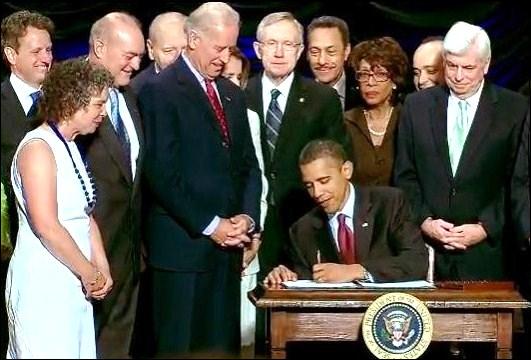
President Obama Signs the Dodd-Frank Wall Street Reform and Consumer Protection Act, July 21, 2010
Progressives have every right to harbor a seething contempt toward the Wall Street wing of the Democratic Party. Democrats controlled both houses of Congress in the last two years of George W. Bush’s presidency as Wall Street blew itself up and Congress passed the massive taxpayer bailout of the Wall Street mega banks. (Democrats held fewer than 50 seats in the Senate but they held operational majority since two Independents caucused with them.)
In Obama’s first two years in office (January 2009 to January 2011), Democrats had increased their majorities in both chambers of Congress. Democrats were in charge when it became crystal clear from Congressional hearings that Wall Street mega banks had created, through unbridled greed and corruption, the most catastrophic financial crash since the Great Depression. Democrats were in charge when it became profoundly evident that Wall Street needed a major regulatory overhaul and that simply tinkering around the edges of reform would put the U.S. economy in grave danger in the future.
Notwithstanding the economic devastation being experienced at the time, the Dodd-Frank financial reform legislation which was signed into law by Obama on July 21, 2010 was a vast document of fluff that failed miserably at reforming Wall Street. The legislation was supposed to rein in derivatives. It did not. It was supposed to eliminate the need for future taxpayer bailouts of the too-big-to-fail banks. It did not. It was supposed to prevent Wall Street investment banks from gambling with the Federally insured deposits they held under their roof. It did not. It was supposed to prevent rating agencies from taking payments from Wall Street banks and then handing out triple A ratings on toxic debt. It did not. It was supposed to put a tough cop on the beat to police the Wall Street banks. Instead, it gave increased power to the Federal Reserve, which, then and now, continues to outsource its policing function to the intentionally incompetent and disastrously conflicted New York Fed, whose share owners are the very banks it regulates. As we wrote previously in 2013 — three years after the passage of the Dodd-Frank legislation:
“In early 2012, as JPMorgan was building up an unmanageable position in illiquid, toxic derivatives in a dark corner of its trading empire in London using the insured deposits of its banking customers, its Chairman and CEO, Jamie Dimon, was sitting on the Board of Directors of the New York Fed. As it was being investigated by the New York Fed, Jamie Dimon continued to sit on its Board, serving out his two terms which ended at the end of 2012. This debacle became infamously known as the London Whale trades. JPMorgan has owned up to $6.2 billion in losses from those derivatives.
“In March, Senator Carl Levin told the Senate’s Permanent Subcommittee on Investigations that JPMorgan, in carrying out the London Whale trades, ‘piled on risk, hid losses, disregarded risk limits, manipulated risk models, dodged oversight, and misinformed the public.’ Does that sound like a Wall Street firm that’s afraid of its regulators?”
…

