

Courtesy of Pam Martens
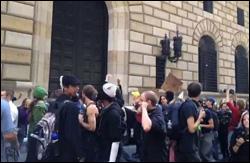
Occupy Wall Street Protesters Outside the New York Fed, September 17, 2012
Last Wednesday, the Federal Reserve Board of Governors rushed through a rule change to its stress test for the too-big-to-fail banks on Wall Street, putting it into immediate effect without the customary 30-day delay. It is further noteworthy that the Board did not get the customary unanimous vote to move forward with the rule change: Fed Board Governor Lael Brainard, arguably the smartest member of the Board, voted against the rule change while the four other Governors, including Chairman Jerome Powell, voted in favor.
There is a strong case that can be made that the rushed rule change was to protect the biggest banks on Wall Street – the ones serially charged with crimes around the globe – while putting the public at risk of another epic financial collapse.
What the rule change effectively did was to tell the recidivist banks that their on-site Federal regulator, the Federal Reserve Bank of New York, was not going to flunk them in their stress test for serious lapses in risk management like failing to report and/or control money laundering, insider trading, bribery, or market rigging, to name only a few typical breaches of law.
To fully comprehend the hubris of this rule change, you need to know three important things upfront. First, the Federal Reserve Board of Governors, a so-called independent agency of the U.S. government, is nothing more than a titular head of the Federal Reserve when it comes to supervision of the big banks. Its Governors are indeed appointed by the President of the United States but it has outsourced supervision of the big Wall Street banks to the cozy and compromised Federal Reserve Bank of New York. The New York Fed is literally owned by the largest banks on Wall Street. They are its shareholders; they appoint two-thirds of its Board of Directors and three of those seats are currently filled by bank CEOs.
…

