


Courtesy of Pam Martens.
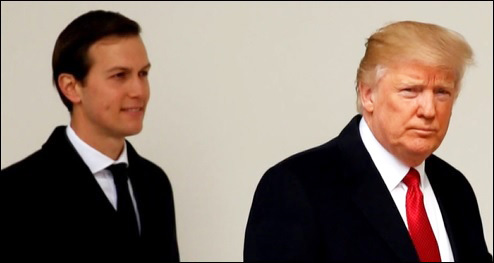
Jared Kushner and President Donald Trump
By Pam Martens and Russ Martens: May 20, 2019 ~
Yesterday, every U.S. television network carried the New York Times bombshell that Deutsche Bank employees had flagged suspicious activity in the bank accounts of President Donald Trump and his son-in-law, Jared Kushner, involving foreign money flows, but their superiors at Deutsche Bank did not allow the reports to be filed with the Financial Crimes Enforcement Network (FinCEN), a unit of the U.S. Treasury that is mandated under law to receive and investigate such reports. From there the news went viral around the globe, landing on cable news, Reuters and in European newspapers. (Shortly after trading opened this morning on the New York Stock Exchange, Deutsche Bank’s stock traded at an all-time low of $7.39. This was a $120 stock in 2007.)
There is no disputing the fact that this is a critical development, for the following key reasons that we will address one by one.
First, Trump is Tweeting away this morning, bashing the New York Times’ report as “Fake News” and adding that “Fake Media” “uses unnamed sources (because their sources don’t even exist).” That retort has worked well for Trump in the past but it’s not going to fly this time around. The Times carries a photo of the Deutsche Bank whistleblower, Tammy McFadden, one of the five sources for their story. She is described as “a longtime anti-money laundering specialist in Deutsche Bank’s Jacksonville office,” who “found that money had moved from Kushner Companies to Russian individuals,” and “concluded that the transactions should be reported to the government — in part because federal regulators had ordered Deutsche Bank, which had been caught laundering billions of dollars for Russians, to toughen its scrutiny of potentially illegal transactions.”
McFadden then drafted a Suspicious Activity Report (SAR). McFadden and two other Deutsche Bank managers told the Times that the normal procedure was for the SAR to be “reviewed next by a team of anti-money laundering experts” who were independent of the business unit where the transaction originated. That didn’t happen. The very unit that had handled the transaction, the Private Bank, blocked the report from moving on to FinCEN, according to McFadden and her former colleagues. McFadden told the Times she was fired from Deutsche Bank last year after raising concerns about the bank’s money laundering practices.
…

