Francis Fukuyama’s The End of History and the Last Man is, particularly relative to its prescience, one of the most misunderstood books of all time. Aris Roussinos explained at UnHerd:
Now that history has returned with the vengeance of the long-dismissed, few analyses of our present moment are complete without a ritual mockery of Fukuyama’s seemingly naive assumptions. The also-rans of the 1990s, Samuel P. Huntington’s The Clash of Civilisations thesis and Robert D. Kaplan’s The Coming Anarchy, which predicted a paradigm of growing disorder, tribalism and the breakdown of state authority, now seem more immediately prescient than Fukuyama’s offering.
Yet nearly thirty years later, reading what Fukuyama actually wrote as opposed to the dismissive précis of his ideas, we see that he was right all along. Where Huntington and Kaplan predicted the threat to the Western liberal order coming from outside its cultural borders, Fukuyama discerned the weak points from within, predicting, with startling accuracy, our current moment.
Consider this paragraph from the book:
Experience suggests that if men cannot struggle on behalf of a just cause because that just cause was victorious in an earlier generation, then they will struggle against the just cause. They will struggle for the sake of struggle. They will struggle, in other words, out of a certain boredom: for they cannot imagine living in a world without struggle. And if the greater part of the world in which they live is characterized by peaceful and prosperous liberal democracy, then they will struggle against that peace and prosperity, and against democracy.
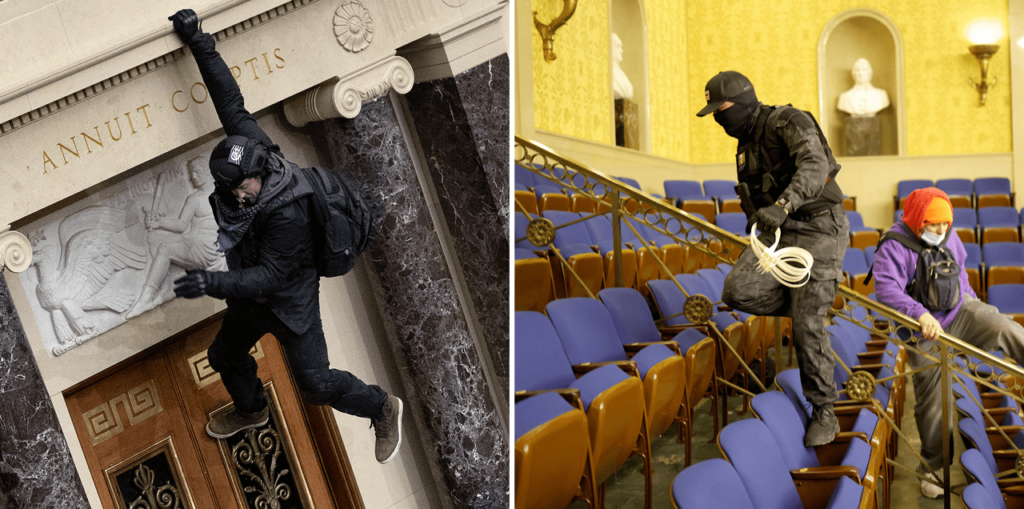
It was hard to not think of that paragraph as scenes emerged from last week’s invasion of the U.S. Capitol in an attempt to overturn a democratic election, particular those members of the mob LARPing a special forces military operation, and in the following days when it became clear just how many members of the mob were otherwise well-off members of society. Was belief that President Trump won the election a sufficient motivation to attack the Capitol, or, underneath it all, was there something more?
Win McNamee via Getty Images
I won’t pretend to know the answers to that question — this is a blog about technology and strategy, not philosophy and history. The events that followed Wednesday, though, bring to mind Fukuyama’s warning that history may be restarted by those unsatisfied with its end.
The End of the Beginning
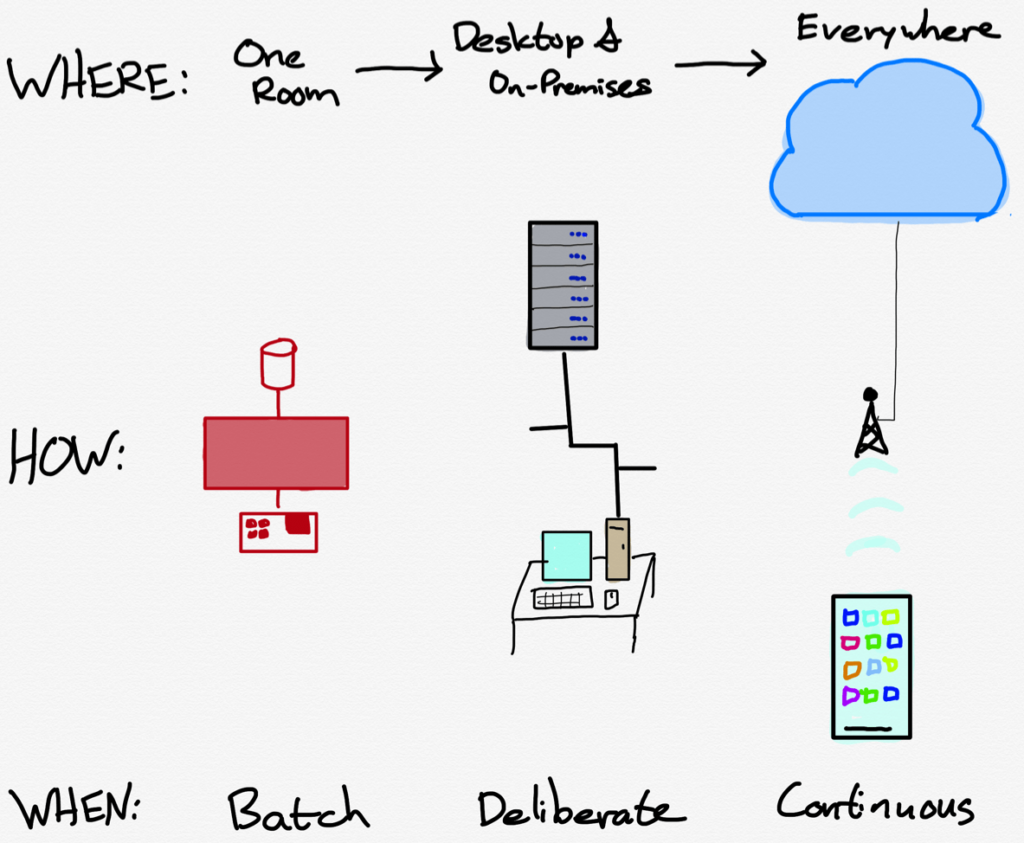
One year ago I wrote The End of the Beginning, which posited that the history of information technology was not, as popularly believed, one of alternating epochs disrupted by new paradigms, but rather a continuous shift along two parallel axis:
The evolution of computing from the mainframe to cloud and mobile
The place we compute shifted from a central location to anywhere; the time in which we compute shifted from batch processes to continuous computing. The implication of viewing the shift from mainframe computing, to personal computing on a network, to mobile connections to the cloud, as manifestations of a single trend was just as counterintuitive:
What is notable is that the current environment appears to be the logical endpoint of all of these changes: from batch-processing to continuous computing, from a terminal in a different room to a phone in your pocket, from a tape drive to data centers all over the globe. In this view the personal computer/on-premises server era was simply a stepping stone between two ends of a clearly defined range.
Another way to think about the current state of affairs is that it is the inevitable economic endpoint of the technological underpinnings of the Internet.