


The Roblox Microverse
Courtesy of Ben Thompson
The degree to which Stratechery Weekly Articles are pre-planned varies; Eddy on Twitter, though, had this article pegged:
Tomorrow, after a number of delays, including switching from an IPO to a Direct Listing, is finally the day that Roblox goes public; it’s a company I can’t wait to write about.
The Evolution of Video Games
The article Eddy was replying to was Clubhouse’s Inevitability, particularly this chart:
The most obvious difference between Clubhouse and podcasts is how much dramatically easier it is to both create a conversation and to listen to one. This step change is very much inline with the shift from blogging to Twitter, from website publishing to Instagram, or from YouTube to TikTok.
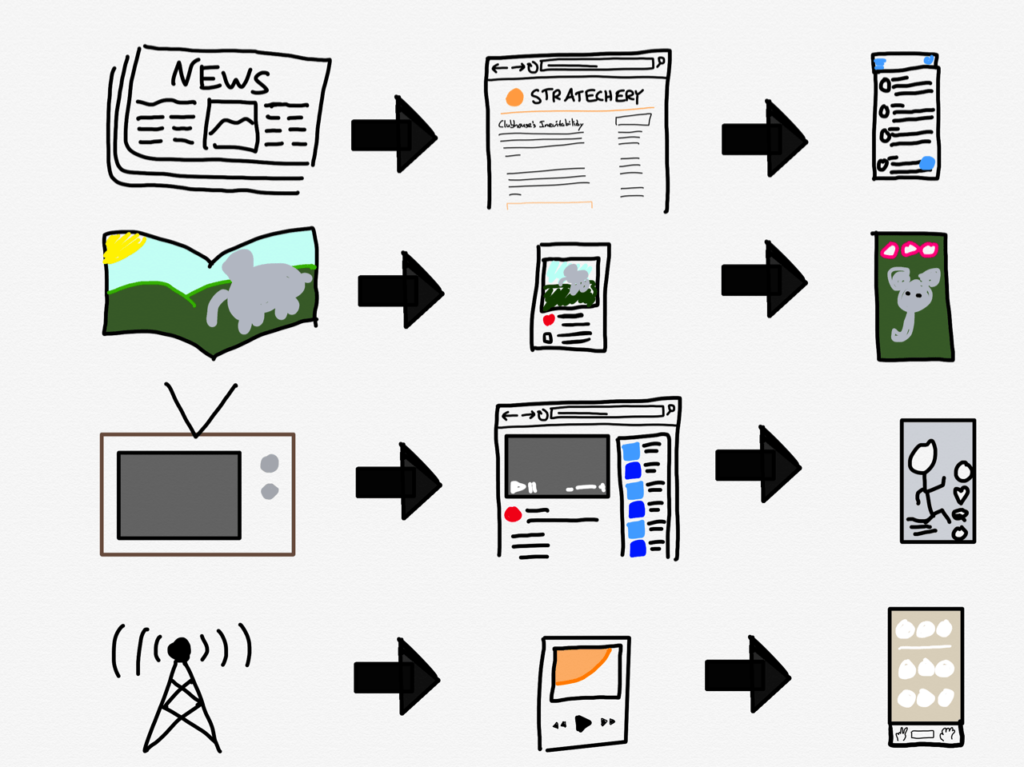
Secondly, like those successful networks, Clubhouse centralizes creation and consumption into a tight feedback loop. In fact, conversation consumers can, by raising their hand and being recognized by the moderator, become creators in a matter of seconds.
Compare this to how Roblox describes their business in their S-1:
An average of 36.2 million people from around the world come to Roblox every day to connect with friends. Together they play, learn, communicate, explore, and expand their friendships, all in 3D digital worlds that are entirely user-generated, built by our community of nearly 7 million active developers. We call this emerging category “human co-experience,” which we consider to be the new form of social interaction we envisioned back in 2004. Our platform is powered by user-generated content and draws inspiration from gaming, entertainment, social media, and even toys.
Here’s the question, though: with regard to Eddy’s question, how might you fit video games onto this evolution of media framework? You could start with analog games, progress to video games, and then to casual games, as Eddy suggested, but it’s worth noting that video games preceded the web by many years; I think it makes more sense to make traditional video games the base unit. More importantly, that graphic was about creation, not consumption, and in that regard, video games fit quite nicely:
- Step 0 — Pre-Internet: The primary way to distribute video games was on consoles, which were controlled by the console makers; computer gaming was more open, but still required significant distribution capabilities. This was the newspaper era of video game publishing.
-
Step 1 — Democratization: The Internet made it possible to distribute games directly, meaning that anyone could be a publisher; over time the increase in broadband penetration made casual cloud-gaming (originally via Flash and later on Facebook) much more accessible.
-
Step 2 — Aggregation: Mobile dramatically increased the market for video games by ensuring nearly everyone had a video game device in their pockets. Note that this increased the market in two ways: first, there were more potential players, and two, all potential players had more opportunities to play games. Mobile, though, meant App Stores. This was a boon in that it made it easy to distribute video games in a way that customers were willing to trust and experiment with, and built-in payments unlocked entirely new ways of making money. It also meant that App Stores were the only way to reach customers, and you had to pay 30% for the privilege (these advantages and disadvantages are, of course, the exact same).
-
Step 3 — Transformation: This step is when the medium in question becomes something fundamentally different because of the Internet. I explained in Clubhouse’s Inevitability:
Even with the explosion of content resulting from democratizing publishing, what was actually published was roughly analogous to what might have been published in the pre-Internet world. A blog post was just an article; an Instagram post was just a photo; a YouTube video was just a TV episode; a podcast was just radio show. The final step was transformation: creating something entirely new that was simply not possible previously.
Along those lines, a lot of video games, particularly mobile games, are just mobile versions of what has been available for decades; at the same time, video games have incorporated a lot of things that are only possible on the Internet. Multi-player games have been widespread for over twenty years, and the entire concept of in-app purchases has transformed business models. Both are uniquely enabled by the Internet. Even with that caveat, though, Roblox is something entirely new.
The Metaverse
Back to the Roblox S-1:
Some refer to our category as the metaverse, a term often used to describe the concept of persistent, shared, 3D virtual spaces in a virtual universe. The idea of a metaverse has been written about by futurists and science fiction authors for over 30 years. With the advent of increasingly powerful consumer computing devices, cloud computing, and high bandwidth internet connections, the concept of the metaverse is materializing.

