

No surprise here.
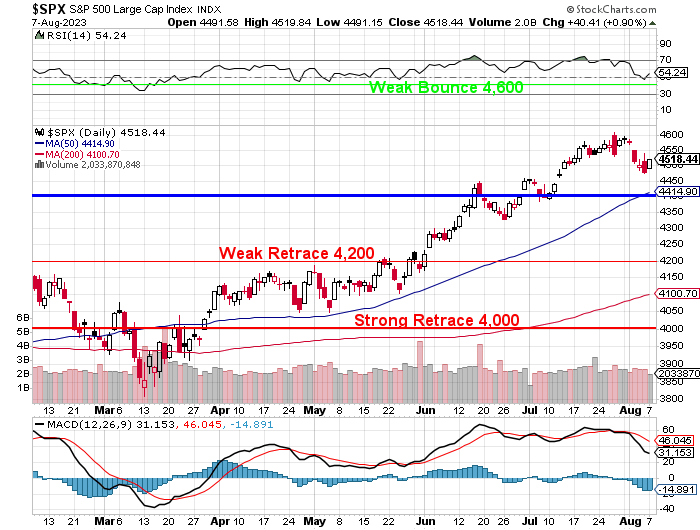
As I said to our Members in yesterday Live Chat Room: “We’re still working on weak bounces from last week so it’s going to be hard to impress me today and, of course, Monday…” Monday’s are often low-volume BS and yesterday’s volume was half of Friday’s and the gains are pretty much all gone this morning already.
We’re still in very positive territory so there’s nothing to worry about – yet… NEXT WEEK is when we worry as the S&P 500s 50-day moving average is likely to run into the index and THEN we will see if there’s truly support for these 30x valuations after Q2 earnings have dropped:
Yesterday’s Consumer Credit Report showed US consumers increased their borrowing by $17.9Bn, mainly due to higher nonrevolving credit, such as car loans and student loans. This indicates that consumers are taking advantage of low interest rates and Government stimulus programs to finance their purchases of durable goods and education expenses. This could support the economic recovery and consumer demand. However, it also means that consumers are accumulating more debt and may face difficulties in repaying their loans if interest rates rise or income falls.
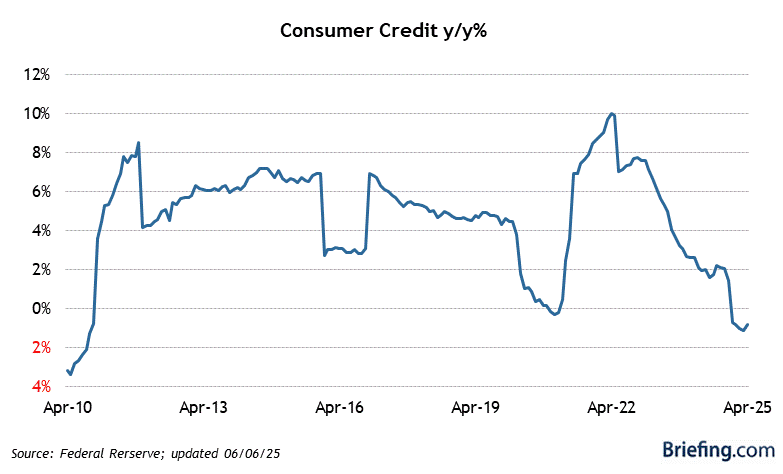
The report also shows that revolving credit, such as credit cards, decreased by $3Bn, suggesting that consumers are getting cautious about their spending and are paying off their balances. This could reflect the high inflation and uncertainty about the economic outlook that have dampened Consumer Confidence.
 As I have long maintained, this economic uncertainty, inflation and turmoil won’t settled until we find an equilibrium between prices and wages and we are still MILES away from that as the UAW are demanding 40% wage increases from F, GM and STLA. 40% sounds like a lot but in the last 3 rounds of negotiations, going back to 2010, the UAW made contract concessions to get the auto industry back on it’s feet and starting wages are currently $17, 40% of $17 is $7 to $24/hr, which would be $3,840/month – still not enough to buy the cars they are building.
GM made $5Bn in the first half of 2023, STLA made $12Bn and the CEOs of the Big 3 have been given 40% raises in the past 4 years – that’s where that number is coming from – the CEOs make about $25M a year for telling the workers the companies are broke (they are, in fact, making record profits). We are miles and miles away from equilibrium!
And, before you go blaming the UAW for the price of your car – these price hikes that have led to record profits are BEFORE the UAW’s 4-year concession contracts are expiring (Sept 15th) and, according to a study by the Center for Automotive Research in 2015, the average total cost of producing a vehicle in North America was $30,651and $2,616 of that was Labor Costs – including ALL benefits – even pensions.
So the workers are asking for $1,046.40 over the next four years and Ford just cut the price of the F150 by $10,000 – they could have just cut it by $9,000 and helped their workers keep up with inflation, right?
Meanwhile, China experienced a significant decline in its Exports, with outbound shipments dropping by 14.5% compared to last year. This decline is the steepest year-over-year drop since February 2020, during the early days of Covid. The major contributors to this decline were exports to the United States and the European Union, which plunged by over 20% each. In contrast, Chinese exports to Russia saw a remarkable increase of 52% in July, primarily driven by sales of high-value goods like automobiles but, unfortunately, Russia’s demand is minute by comparison.
This drop in exports points to several key factors affecting China’s Economic Landscape:
-
Shift in Consumer Spending Patterns: The decline in exports can be traced back to a shift in consumer spending patterns. Western consumers, especially in developed countries, started shifting their spending from goods like furniture and electronics to services such as entertainment and dining out. This shift began in October of the previous year and has continued to impact China’s export sector.
-
Geopolitical Tensions: Increasing geopolitical tensions between China and Western countries, particularly the United States, have led to concerns about supply chain reliability. Western manufacturers have been seeking to diversify their supply chains away from China, which has the potential to erode trade ties and impact China’s exports.
-
Global Trade Slowdown: China is not the only country facing export challenges. Other export-driven economies in Asia, like South Korea (down 16.5% in July) and Vietnam, have also experienced declining exports due to weakening global trade demand. Manufacturing sectors in these countries have shown signs of contraction, indicating weak underlying demand from Western markets.
-
Global Growth Slowdown: The overall global growth outlook for the second half of 2023 is pessimistic, according to the United Nations Conference on Trade and Development. Persistent inflationary pressures in the U.S. and Europe are expected to continue limiting consumer spending and business borrowing, potentially leading to a global growth slowdown.
-
Domestic Economic Concerns: The decline in exports exacerbates China’s domestic economic challenges. Despite an initial recovery following the easing of Covid-related restrictions, China’s economic growth has been losing momentum since April. A struggling housing market, constrained consumer spending, and high youth unemployment are adding to these challenges.
-
Potential for Deflation: The data also suggest that China is on the verge of falling into deflation, a scenario that could have serious consequences for the economy. Falling prices could lead to reduced consumer spending and business investment, potentially pushing the economy into a downward spiral.
On top of that, China’s CRE market is a house of cards that, at this point, can only be held together by massive undeclared bail-outs – so we don’t actually KNOW what is happening in China but it does not look good!
Be careful out there!