 I write at a college level.
Obviously Economics is a complex concept and Investing and Trading requires you to be familiar with more than just the basics and, of course, to keep up on Global Events and to understand the micro and macro effects that news, data, demographics and even politics may have on your investment prospects in order to be a successful investor.
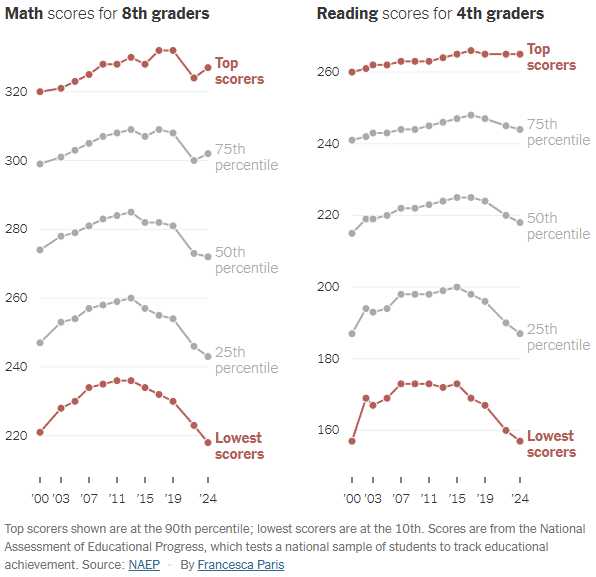
That’s why it’s disturbing to me that the National Assessment of Educational Progress shows a DRAMATIC fall-off in reading and match skills in EVERY quintile (see – I can’t use that word anymore!) except the top-scoring children.
ONLY 32% of 12th graders are reading at or above proficient levels and 40% of the 4th graders are scoring BELOW BASIC reading levels while 1/3 of our 8th graders can’t meet basic reading benchmarks – an all-time high and I would tell you how far above the median that is – but who would understand it???
This is a CRISIS folks – one that is being ignored as the Trump Administration CUTS 15% ($10Bn) of the Department of Education’s annual budget to $67Bn while companies like META pledge to spend $600Bn (60 TIMES that much) developing AI to replace those “dumb” kids in the future Labor Force.
It’s a lot easier to slash the budget when your constituents can’t do the math to understand how badly you are destroying their children’s chances of building lives for themselves, right? 12th grade math scores lost 20 years of progress since Trump’s first term with 40% of 4th graders below their basic math levels. This is not due to Covid – they were not even in Kindergarten during Covid!
Our Secretary of Education, Linda McMahon, knows her audience and so does Donald Trump as research has confirmed that education levels DIRECTLY correlate with voting patterns and economic policy preferences. A less-educated electorate creates:
-
- Policy whiplash as voters struggle to understand complex Economic issues
- Populist susceptibility – simple answers to complex problems always win
- Short-term thinking dominating long-term economic planning
- Increased political volatility affects market stability
Expect more Trump-style policy reversals, tariff chaos, and constitutional crises down the road as an increasingly uneducated electorate chooses leaders who promise simple solutions to complex problems. But it’s not all about politics – Educational attainment dramatically impacts consumer behavior:
The Bottom 80% (Declining Education):
-
-
-
Higher susceptibility to scams (hello, crypto meme coins!)
-
Impulse purchasing over rational financial planning
-
Debt accumulation due to poor financial literacy
-
Brand susceptibility to marketing manipulation
-
-
The Top 20% (Maintaining/Improving):
-
-
-
Informed decision-making and comparison shopping
-
Long-term financial planning and investment strategies
-
Premium brand loyalty based on value, not marketing
-
Technology adoption for productivity gains
-
-
Investment Implication: Double down on premium brands serving educated consumers(like our LULU thesis) while avoiding mass market retailers dependent on increasingly impoverished, poorly-educated consumers. This is George Carlin’s warning on Education and the American Dream playing out right before our eyes!
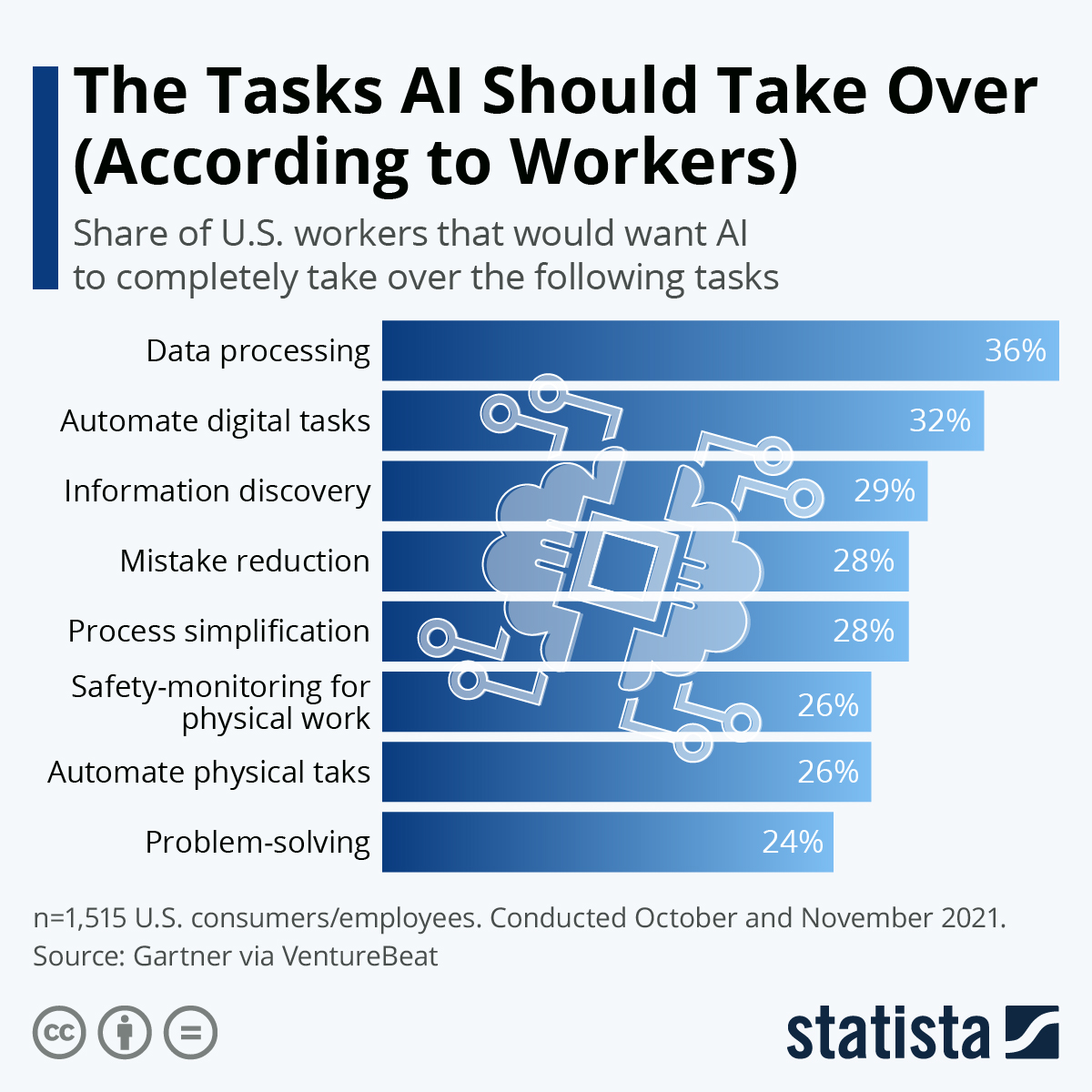 The education crisis accelerates AI adoption by making human workers increasingly obsolete:
-
- AI offers consistent performance vs. workers who can’t read instructions.
- AI has no training costs for basic literacy and numeracy.
- AI offers predictable output vs. a workforce with declining cognitive skills.
- AI offers scalability without educational infrastructure investment (so Trump and McMahon are wise to stop bothering with human children).
- AI infrastructure companies (AVGO, NVDA) become MORE VALUABLE, not less, as the human workforce becomes less capable.
And, of course, the effects of these changes vary by region and those states that support Education (mostly blue) and attract AI and Tech jobs (mostly blue) end up with a “Knowledge Economy” that maintains Property Values and Municipal Finances with Virtuous Cycles of Investment and Development.
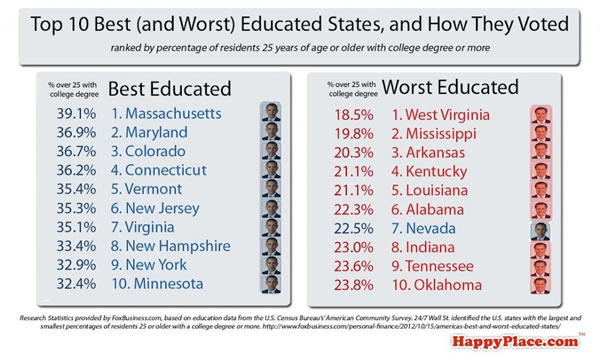
The states with the poorest levels of Education end up becoming “Extraction Economies” where Resources and Cheap Labor are essentially exploited and they lose business to better-educated markets, which erodes their tax-base and that leads to further cuts in Education – locking those states into ever-declining cycles of voting Republican and further dumbing down the population…
🚢 Winners in the “Dumb Money” Economy
1. Predatory Financial Services 📈
-
-
-
-
Payday lenders exploiting financial illiteracy
-
Cryptocurrency scams targeting uneducated investors
-
High-fee investment products for unsophisticated buyers
-
Insurance fraud and overpricing
-
-
-
2. Simplified Consumer Products 📈
-
-
-
-
Fast food over complex meal preparation
-
Pre-packaged solutions over DIY approaches
-
Subscription services with hidden fees
-
Impulse purchase retailers (Dollar stores, convenience)
-
-
-
3. Entertainment/Distraction Industries 📈
-
-
-
-
Gaming and gambling exploiting poor impulse control
-
Social media addiction monetization
-
Reality TV and simplified content
-
Sports betting targeting financially illiterate
-
-
-
Losers in the Education Collapse
1. Complex Financial Services 📉
-
-
-
-
Traditional investment advisors (clients can’t understand advice)
-
Insurance products requiring educated evaluation
-
Retirement planning services (too complex for target market)
-
Estate planning (requires long-term thinking)
-
-
-
2. Quality Education Services 📉
-
-
-
-
Traditional universities (declining demand/ability to pay)
-
Professional development (workers can’t benefit)
-
Business consulting (clients can’t implement recommendations)
-
Training and certification programs
-
-
-
3. Information-Based Industries 📉
-
-
-
-
Newspapers and journalism (audience can’t read/understand)
-
Book publishing (declining literacy)
-
Research and analysis (no market for complexity)
-
Educational technology (students lack foundational skills)
-
-
-
![Think about how stupid the average person is, and then realize than half of them are stupider than that." - George Carlin [563x316] : r/QuotesPorn](https://preview.redd.it/mh1gghyc6g2y.jpg?auto=webp&s=a7711feef59a3ab81c71d534106d809e5ba2673d) The Meta-Investment Thesis: Betting on Stupid
The Meta-Investment Thesis: Betting on Stupid
The harsh reality: In a society where 40% of 4th graders can’t read at grade level, successful investing requires betting on the consequences of widespread ignorance.
Strategic Positioning:
1. Short-Term Trading 📈
-
-
-
-
-
-
Increased market volatility from uninformed political decisions
-
Momentum investing over fundamental analysis
-
Technical trading over research-based strategies
-
Options strategies exploiting increased volatility
-
-
-
-
-
2. Long-Term Holdings 📈
-
-
-
-
-
-
AI and automation replacing human workers
-
Premium brands serving educated elites
-
Infrastructure benefiting from government spending (since voters can’t evaluate efficiency)
-
International diversification away from U.S. decline
-
-
-
-
-
3. Defensive Strategies 📉
-
-
-
-
-
-
Avoid complex businesses requiring educated consumers
-
Avoid democratic accountability themes (voters can’t evaluate performance)
-
Avoid long-term infrastructure investments (political consistency impossible)
-
Avoid human capital intensive industries
-
-
-
-
-
Portfolio Construction for the Post-Literate Economy
Core Holdings (40%):
-
-
-
-
-
-
AI Infrastructure (AVGO, data centers) – replacing human incompetence
-
Premium Brands (serving educated elite) – pricing power over informed consumers
-
International Assets (escaping U.S. educational decline)
-
-
-
-
-
Tactical Positions (35%):
-
-
-
-
-
-
Volatility plays (political chaos from uneducated voters)
-
Predatory services (exploiting financial illiteracy)
-
Simplified products (serving dumbed-down consumers)
-
-
-
-
-
Hedges (25%):
-
-
-
-
-
-
Gold/Bitcoin (monetary policy chaos from economic illiteracy)
-
Geographic arbitrage (betting on educated regions vs. declining areas)
-
Short positions on complex businesses requiring smart consumers
-
-
-
-
-
![The dumbing down of America..." Carl Sagan [720x720] : r/QuotesPorn](https://external-preview.redd.it/Tw_qmYLzaLQcPqPgsyDkd1FNLqtUJ2jvjuuQZzfLFrw.jpg?width=640&crop=smart&auto=webp&s=e50ad8547a99fcf5cc12c599d2910202db7161bd) We’re witnessing the first generation in American history that will be less-educated than their parents while simultaneously having access to MORE INFORMATION than any generation in human history! The Investment Opportunity: While traditional investors wring their hands about social decline, smart money recognizes that betting against American educational competence is becoming the most reliable trade of the 21st century.
We’re witnessing the first generation in American history that will be less-educated than their parents while simultaneously having access to MORE INFORMATION than any generation in human history! The Investment Opportunity: While traditional investors wring their hands about social decline, smart money recognizes that betting against American educational competence is becoming the most reliable trade of the 21st century.
Companies like META are spending $600Bn on AI infrastructure partly because they can’t find humans capable of doing increasingly complex work. That’s not a bug in the economic system – it’s a FEATURE for Investors who are positioned correctly for what is shaping up to be the decline of our Empire.
The American Education Crisis isn’t a temporary setback – it’s a permanent structural shift toward a two-tiered society. Successful Investing in this environment requires abandoning nostalgia for an educated Democracy and embracing the profit opportunities created by the systematic ignorance being fostered by our elected “leaders.“