

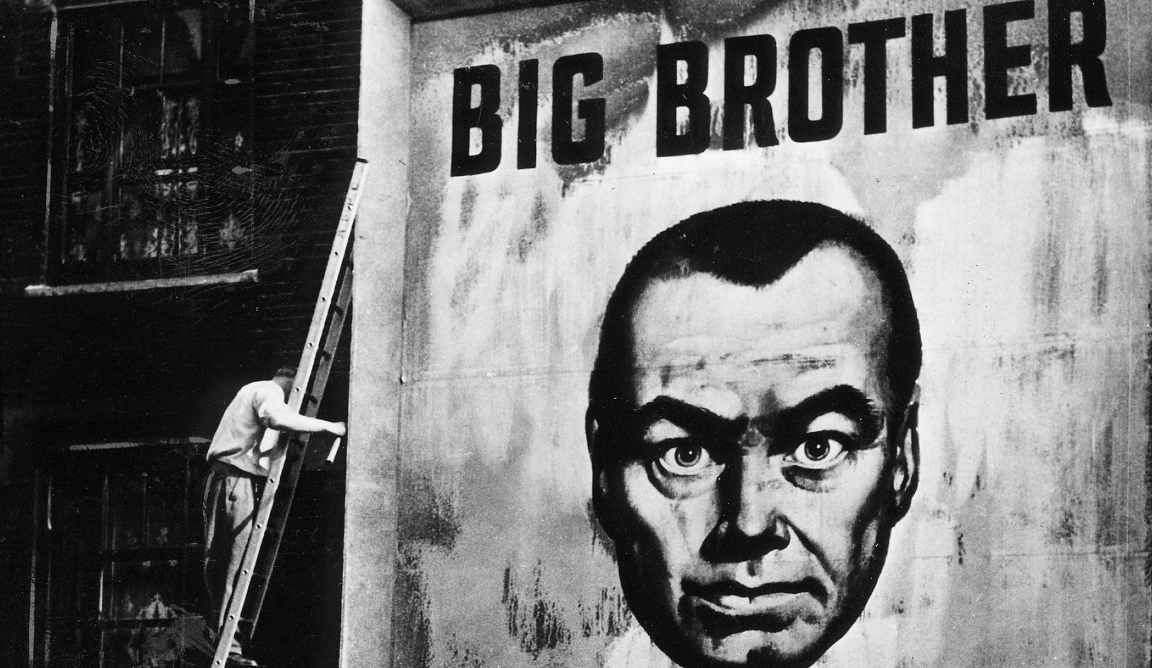
A new film argues that, in an era of rising authoritarianism, audiences have become too numb to the speculative force of 1984.
George Orwell was dying when he wrote 1984 in the late 1940s on the desolate Isle of Jura in Scotland’s Inner Hebrides. Tuberculosis ravaged his body, and typing thousands of words a day only weakened him further. His skin flaked off. Blisters burst across his throat. Feverish and emaciated, he endured painful procedures to support his failing lungs, but the treatments were too late. Eventually, in 1950, Orwell succumbed to the disease.
Close-ups of microscopic tuberculosis bacteria fill the screen in the opening minutes of the documentary Orwell: 2+2=5—images as bold and unnerving as what follows. Directed by the Oscar-nominated filmmaker Raoul Peck, the film examines an idea popularized by 1984: that blatant falsehoods can, through propaganda, be accepted as truth. That conceit, along with Orwell’s state of mind during his final months, has been scrutinized for decades—by high-school students, biographers, and other documentarians. But Peck builds out a bigger argument, using material provided by the Orwell estate—including the writer’s letters, essays, and diary entries—to trace the authoritarian tactics that can suppress truth and lay out what he sees as a disturbing pattern: one of wide-scale complacency in the decades after Orwell’s death. Generations of readers have recognized the prescient warnings of 1984. Yet according to Peck’s film, recognizing that reality can resemble Orwell’s dystopian masterpiece has led to numbness, rather than meaningful change.

