

Justin Wolfers On Trump’s No Data No Problems
By Fast Politics w/ Molly Jong-Fast
Summary:
In this episode of Fast Politics, host Molly Jong-Fast speaks with economist Justin Wolfers about the consequences of the federal government shutdown under President Trump, focusing on the loss of economic data and the broader erosion of truth and institutional competence.
Wolfers opens humorously, saying the administration’s motto seems to be “no numbers, no problems,” since government data collection halts during shutdowns. He explains his personal connection to the monthly “jobs day” reports, recalling his early career at the Reserve Bank of Australia and later his wife’s work at the U.S. Department of Labor. The absence of new labor data, he says, feels like a void—symbolic of a government turning away from transparency and evidence.
They discuss how private data, like ADP’s jobs reports, can’t fill the gap—calling them unreliable “rebound relationships.” Wolfers notes that while other sources (like Federal Reserve industrial data or OpenTable reservations) still exist, the economic picture is now “foggy.” This uncertainty is particularly dangerous at a possible economic turning point: tariffs and an immigration slowdown are already dragging on growth, but without reliable data, policymakers can’t tell whether the economy is merely cooling or sliding toward recession.
The conversation broadens to the shutdown’s human cost. Wolfers condemns the administration for “making the most vulnerable pawns in a political game,” arguing that while GDP might not immediately show the damage, the moral and institutional toll is far more serious. He ties this to a global economic pattern: countries that elect populist leaders like Trump see GDP about 15% lower a decade later due to eroded trust, rule of law, and state capacity.
They then turn to the Supreme Court case over Trump’s tariffs. Wolfers notes that tariffs are, by definition, taxes—and taxing power belongs to Congress. The administration’s legal argument, inventing a distinction between “revenue tariffs” and “regulatory tariffs,” is, he says, a fiction. He predicts the Court will strike them down, setting off new “tariff turmoil.”
Wolfers closes by warning that Trump’s administration is historically devoid of qualified economists—“not one in the top 10,000”—and that its attacks on data, expertise, and legality will leave lasting economic scars. Even if short-term GDP doesn’t capture it, he says, the long-term cost is diminished innovation and prosperity.
Transcript (lightly edited):
MOLLY: Welcome back to Fast Politics, Justin Wolfers.
JUSTIN: Hey, Molly!
MOLLY: So the great news for the Trump administration is, when the government is shut down, you don’t get the numbers, right?
JUSTIN: Just like how we solved COVID.
MOLLY: So explain—
JUSTIN: No numbers, no problems.
MOLLY: But he had already, before shutting down, in Trump’s defense, before shutting down the government, fired the head of the Bureau of Labor Statistics.
JUSTIN: He made his position on data very clear. He’s against it.
MOLLY: Yeah.
JUSTIN: He also has a very strong position on truth.
MOLLY: That’s right.
JUSTIN: Optional.
MOLLY: He likes truthiness.
JUSTIN: Yep. In small doses, and only occasionally.
MOLLY: Yes. At this point, does the government give us public data still? Not really? Or yes? Talk us through it.
JUSTIN: It’s a very sad day. So I’m going to make this personal, if I may, Molly.
MOLLY: Please.
JUSTIN: I’ve been a nerd for a very long time. When I left college, my first ever job was at the Reserve Bank of Australia, which is like the Fed. And when you get a job as a baby economist, they give you one tiny sliver of the economy to look after. And my job was the jobs report.
JUSTIN: And so, even as a little baby economist, I would wake up—
MOLLY: In a tiny, tiny country.
JUSTIN: In a magnificent and beautiful country with a functional democracy and a well-functioning economy.
MOLLY: Which you don’t live in anymore.
JUSTIN: Which I have family in, and think about during an Ann Arbor winter.
JUSTIN: But my job was: it would be jobs day, and I would wake up excited for jobs day, even as a 22-year-old. And then I moved to America and I did my PhD and, you know, you forget about the real world for a little while.
JUSTIN: And then my better half, Betsy Stevenson, became the chief economist at the Department of Labor. And so it became this thing: Friday, the first Friday of every month, was jobs day. And she had to get in early and brief the Labor Secretary and talk to the media and crunch the numbers for what was then the first Obama administration.
JUSTIN: And so jobs day was such a big day in our household. Then I was writing for the New York Times, and I used to write about the jobs numbers, and it was all very exciting. And it stayed just a regular part of our monthly life ever since, to the point that I literally—our nanny would walk in and say, “Oh, it’s jobs day today. How are you feeling about the economy?”
JUSTIN: And today I woke up, and it’s the first Friday of the month, and there was an enormous void in my life.
JUSTIN: The sense of checking in on the workers and seeing how they’re doing, of hoping that the economy is moving forward and producing more for more of us, of wondering what’s next, of thinking about policies that could make a difference—I did none of that.
JUSTIN: I sat in a dark room, staring at the corner, rocking backward and forward, crying just one solitary tear down my cheek.
MOLLY: Talk us through this. We don’t have the government data, but we do have some private data. Does that fill the void, or does it not? And why not?
JUSTIN: It’s sort of like, you know, when mom and dad get divorced and then mom starts dating a new guy, but she’s not really sure that he’s going to be around for very long. And maybe they’ve been dating two months and he takes you out to the zoo. That is the ADP jobs report.
JUSTIN: The ADP jobs report is not something well-loved, has no particular track record, is not particularly reliable, and when you need it, you don’t know if it’ll always be there for you.
JUSTIN: So no, we don’t. There’s going to be a lot of press attention around the ADP jobs report, and it came in yesterday or the day before. It was not as bad as the past few have been, but still the important thing is not the comparison with “are you as bad as last month?” but: are you good or bad?
JUSTIN: And it was unequivocally pointing to a weak economy. But I don’t want anyone to place much stock in it. It is a very unreliable indicator. So the truth is, we’re all alone in the dark right now.
JUSTIN: I hope this doesn’t sound like I’m talking about my childhood.
MOLLY: So I want you to— I need you to sort of pull back from the jobs report into what you think the economy… So we have a federal government that’s, A, the longest shutdown ever, and B, pretty hostile to facts, reason, and truth.
MOLLY: So how do you figure out where the economy is, knowing those two things?
JUSTIN: Okay, so: the good news, then the bad news.
JUSTIN: The good news is that government data is not the only data that we have. I did warn you a moment ago that private-sector data about the state of the labor market is not as good as government data. And that’s absolutely, stunningly true. So we have lost some very important things.
JUSTIN: There do exist many other data sets. For instance, the Federal Reserve—which is not affected by the shutdown—collects industrial production. And so we know how much stuff is coming out of factories. We’re not going to be getting GDP data, but we are going to continue to see surveys of companies telling us how they’re doing.
JUSTIN: We have all sorts of things about our daily lives, measured in all sorts of ways. We know restaurant reservations through OpenTable. And we got a lot of practice at this during the pandemic, when a lot of our normal ways of thinking about the economy were broke, and we had to ask: what are some creative ways?
JUSTIN: So the good news is, we’re not purely in the dark. The bad news is, it’s pretty damn foggy. Which is: it’s going to be very hard to have any great sense of what’s going on.
JUSTIN: That really, really matters right now. Why right now? Because it’s possible, but by no means certain, that we’re at a turning point. It’s possible that—remember, we’ve been talking about tariffs for eight months, and I know I’ve bored everyone on this—but actually Trump has only really, truly imposed them a couple of months ago.
JUSTIN: And so if they’re going to have an effect, it would be any day now. We are seeing some hints that the economy has slowed right off—not just because of tariffs, by the way, but also we’ve had a huge shock to immigration. And new people create new stuff. And so that’s something that’s really going to be missing as well.
JUSTIN: Those are two enormous shocks that are hitting the economy right now. And we do know enough to know that the economy was slowing. And the question is: are we slowing to “comfortable,” or are we slowing into a recession? And we actually have no way of knowing that right now, which is a very, very uncomfortable place to be in.
MOLLY: Yeah, that does not sound good.
MOLLY: And then the other question, which—people will be listening to this podcast on Saturday morning, and we will be in the middle of what Sean Duffy lovingly refers to as “airplane Armageddon,” where they basically just slow down air traffic because vibes.
MOLLY: So that seems like it could have larger consequences to the economy.
JUSTIN: Molly, you usually bring me in for the stuff that you feel less confident on—and that’s usually macroeconomics. You feel terrific on finance. And when it comes to fashion, wow. And politics, for sure. And a lovely piece on gender, I thought, the other day in the New York Times.
MOLLY: I love that. Thank you.
JUSTIN: Thank you. So you want to talk about macroeconomics. And the truth is that the government shutdown is going to be a small impact in terms of its overall macro stuff, right? So the headlines aren’t going to change a lot. That’s position one.
JUSTIN: Position two, that’s also true, is every single holiday that’s destroyed, every SNAP beneficiary who went to bed hungry and fearful last night—
MOLLY: Right. And that started now. SNAP—the Trump administration is not funding SNAP, even though federal judges have told them they have to.
JUSTIN: So they should be, and I don’t yet—you know, none of us will believe it until the money’s on the card. Which means the most vulnerable people in our society, who have no stockpile of cash, no way of—
MOLLY: Forty percent of which are children, 20 percent are elderly, and 10 percent are disabled.
JUSTIN: Let’s just pause on that for a moment, Molly.
MOLLY: Yeah.
MOLLY: And 40 percent, FYI, are white.
JUSTIN: Even that—we know that is and should be irrelevant. Let’s pause on the very human thing you said.
JUSTIN: It’s profoundly important. Many of our listeners, just like you and I, Molly, are fortunate enough that we’re doing okay economically. And so we don’t think about, “How will I go to the grocery store next week? What can I afford to buy? What is in the cupboard?”
MOLLY: But we do notice—I mean, I certainly notice that my grocery bills are humongous, like crazy high compared to what they used to be. I mean, they are much more. And if we’re noticing it, it means it’s real everywhere.
JUSTIN: Food prices are up about 3 percent over the past year. I am profoundly disgusted by anyone who can take the most vulnerable and make them pawns in the political game.
JUSTIN: Why don’t we just have a different kind of shutdown, where tax cuts for millionaires get put off for a few weeks? I mean, it’s only a weird accident—and, well, it’s not even a weird accident; it’s also the illegality and the approach of the administration. But it’s one of the most awful things I’ve seen the American government do to its own people, and it doesn’t need to do it.
JUSTIN: There’s money there. We know how to spend it.
JUSTIN: I also want to pan back, because, Molly, you’re like, “Oh, what’s the effect of this shutdown?” and you think about next quarter’s GDP.
JUSTIN: We go back to the things that you were talking about—things like, we no longer have statistical agencies that are being told it’s important to tell the truth. Now, so far, they are telling the truth, and I want to remind our listeners of that.
JUSTIN: But when you fire the head of the BLS for no reason, you’re sending them a message: “You can stop with that truth stuff.” When you have CEOs of major corporations walk into the White House and walk out 10 minutes later with 10 percent less of their company.
MOLLY: That’s called socialism.
JUSTIN: It’s called something-ism.
JUSTIN: When you have the administration ignoring the courts, when you have real questions, when you have ICE on the streets—all of this stuff. None of it shows up in this quarter’s GDP. But it’s more important than anything that shows up in next quarter’s GDP.
JUSTIN: That is not a political statement. That is an economic statement. That is a statement that, on average, the average populist leader over the last hundred years—when you elect them, a decade later—has led GDP to be about 15 percent lower.
JUSTIN: Let me say that in more human terms. GDP is a fancy word for: you elect Trump-like characters, and history shows that a decade later, average income is 15 percent lower. And he could be worse.
JUSTIN: When you look at these big questions—what makes the United States rich and the country of my birth, which was Papua New Guinea, poor—it’s really about state capacity. It’s about how we run our economy. It’s our political and economic institutions. And they’re all being burned down right now.
JUSTIN: None of that is going to be in next quarter’s GDP, but everything we know about how economies work tells us this is overwhelmingly the most important thing going on. And you can’t see it. But what we will know is that our kids are going to wake up in 10 or 20 years’ time, and the opportunities in front of them are going to simply not be there.
JUSTIN: And it’s these unborn opportunities—it’s the new ideas, the new industries that just simply never happened—and that’s the real cost.
MOLLY: They’ll be in China.
JUSTIN: I am trying to figure out how you tell this story. So I need your help, because it’s not a story, it’s economic research.
JUSTIN: This is findings from serious people studying hundreds of years of economic history among every country around the world. And it’s not so obvious. But folks like you, Molly, do a great job telling it as a political story—but this is an economic story as well.
JUSTIN: And the American poor will be poorer as a result of our pie being smaller, as a result of everything that’s going on.
MOLLY: Yeah. Thank you, Elon Musk.
MOLLY: So let’s talk about where we are right now when it comes to: we don’t have the data, we have these tariffs, we have this Supreme Court fight—this insane Supreme Court fight. Donald Trump has the power to do everything he’s ever wanted to do, period, paragraph.
MOLLY: The questions with the Supreme Court—this case, this tariff case—are so big because the courts could decide that Trump doesn’t have the economic power to do these things, and it could not necessarily matter, right? Like, they could say he has time to pay back, or he has this, or he has that.
MOLLY: So I would love it if you could explain to us—don’t predict the future, but just lay out what the possible lanes are.
JUSTIN: I think what you just said is, “Can you be an economics professor for about five minutes?” but I’m not sure why.
MOLLY: And talk about the Supreme Court case—the tariffs in the Supreme Court.
JUSTIN: Yeah. Okay. So here are the critical things for people to understand.
JUSTIN: The Constitution gives the power to tax to Congress. Congress has delegated some of those authorities to the White House because Congress understands that Congress is not very nimble. And so for things like national security and so on, you can levy new tariffs through the White House without Congress. There’s a process, but that’s it.
JUSTIN: Trump decided he granted himself a new set of powers that had never been used before. All of the tariffs that are on individual countries—on China, on Canada, and actually on every country around the world—80 percent of what he’s done has been country-by-country tariffs. There’s no legal authority for that. Trump claims he gets one through what’s called the Emergency Powers Act.
JUSTIN: The Emergency Powers Act—two things are really important about it. One, nowhere does it mention the word “tariff” or “tax.”
MOLLY: You’re such a stickler for these words.
JUSTIN: Second—well, good that you’re thinking about that, because the second thing is: stickler for words—it’s called the Emergency Powers Act. So I know he wants the powers. I think that means you’ve got to have the emergency.
MOLLY: As Justice Amy brought up: what is the national security reason for—you know, you could say Tokyo, you know, you could say Japan, but then you can’t also say—
JUSTIN: Tariffs on bananas.
MOLLY: And Milan and Italy. Like, it has, you know—
JUSTIN: What about the aggression coming from north of the border—those Canadians?
MOLLY: Yeah.
JUSTIN: Far out. Won the World Series—lost the World Series, even.
MOLLY: That’s good.
JUSTIN: So those are the central issues. I listened to the Supreme Court argument. They actually focused almost exclusively on the first of those, which was: does the Emergency Powers Act give the president the right over tariffs?
JUSTIN: The government’s view was, “Oh, if tariffs work properly, no one will ever buy anything from abroad, which means we’ll collect no revenue. So therefore, the revenue is merely incidental. This is about regulating other countries.”
JUSTIN: The justices fought back, and they said, “If you want people to not buy from other countries, here’s a simpler thing: have an embargo.” So it was: the Boston Tea Party, not the Boston Embargo Party, was sort of the claim.
JUSTIN: So, in fact, the government made up a new word. It took me a long time to realize they made up a new word. They talked about “revenue tariffs” versus “regulatory tariffs.” One of these—there’s actually only tariffs.
JUSTIN: The book behind me on the bookshelf—I might have written it—defines a tariff as a tax on imports. It is a tax.
JUSTIN: So the government wants to claim there’s something called a “regulatory tariff.” It’s literally a word they just invented. Doesn’t exist.
JUSTIN: So that’s where most of the argument was. The justices were pretty hostile, because when Congress wants to get rid of its taxing powers, it tends to be very, very, very clear. And it didn’t even use the word here.
JUSTIN: But then you still get to the second problem, which is: even if it had the power, does Trump have a national emergency? This is where, as an economist, the administration says, “We have a national emergency because we have unbalanced trade with specific countries.” That’s what’s called a bilateral trade deficit.
MOLLY: Right.
JUSTIN: No economist alive thinks they matter.
MOLLY: Right.
JUSTIN: Not only do we not think they’re an emergency—we don’t even think they’re interesting.
MOLLY: So even like a Kevin Hassett?
JUSTIN: Even Kevin Hassett, if you tied him down and injected him with honesty juice.
MOLLY: Yeah. Poor Kevin Hassett.
JUSTIN: It would take a lot of honesty juice.
MOLLY: What about Stephen Moore?
JUSTIN: So stupid that it hurts.
MOLLY: I mean, I just want to know: who is the dumbest MAGA economist?
JUSTIN: I am going to be really nice. I’m just going to say I’m glad that there are people—no, I can’t even say nice things. I’m just going to stay out of that.
JUSTIN: But, like, serious point for the audience: what happens when a new administration comes to town is, usually, they recruit the best and the brightest. Every administration, not only in my lifetime—in the previous 50 years—you can look at who was the chair of the Council of Economic Advisers, who were the nerds and the wonks around the president, and they were the best and brightest of their generation. Many former Nobel Prize winners, for instance.
JUSTIN: What we have in the current White House is: you can take any ranking of the horsepower of economists—and many exist, by the way—there is no one in the White House who is in America’s 10,000 best economists. That’s not a hint of exaggeration; it’s a quantitative statement.
JUSTIN: They’ve gone dragging through the gutter. Stupid is as stupid does. I don’t want to be that guy. I hate being that guy. But it’s not a well-advised White House.
JUSTIN: Maybe incompetence is part of the strategy.
MOLLY: We’re out of time. What are you going to watch for over the next couple of weeks—economic indicators? What’s coming down the pike?
JUSTIN: I think the most interesting thing is going to be this Supreme Court tariff case. It’s probably going to happen quickly, according to the legal nerds I talk to. Not “tomorrow” quickly, but maybe even before Thanksgiving.
JUSTIN: That’d be amazing, wouldn’t it? Happy Thanksgiving—talk about tariffs around the turkey.
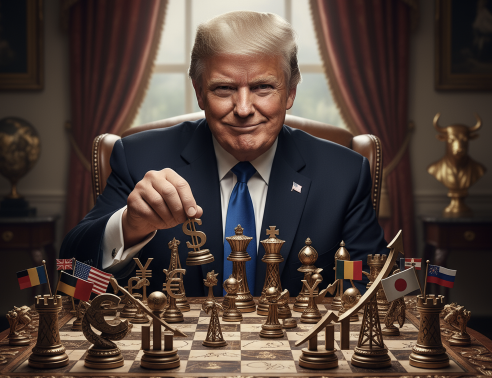
JUSTIN: If, as I expect, the Trump tariffs are ruled illegal, we’re going to move from eight months of unconstitutional, illegal tariff turmoil that have created all sorts of headaches to a whole new set of tariff turmoil—some of which, in the future, may even be constitutional—but it’ll be this crazy, crazy soap opera in which the president tries to run an economy by pretending he, and he alone, can move the pieces around the global economy chessboard.
JUSTIN: So if you think you’ve seen mayhem, strap in. There’s plenty more ahead.
MOLLY: I was told trade wars are good and easy to win. Thank you, Justin.
JUSTIN: Thank you, Molly.

