

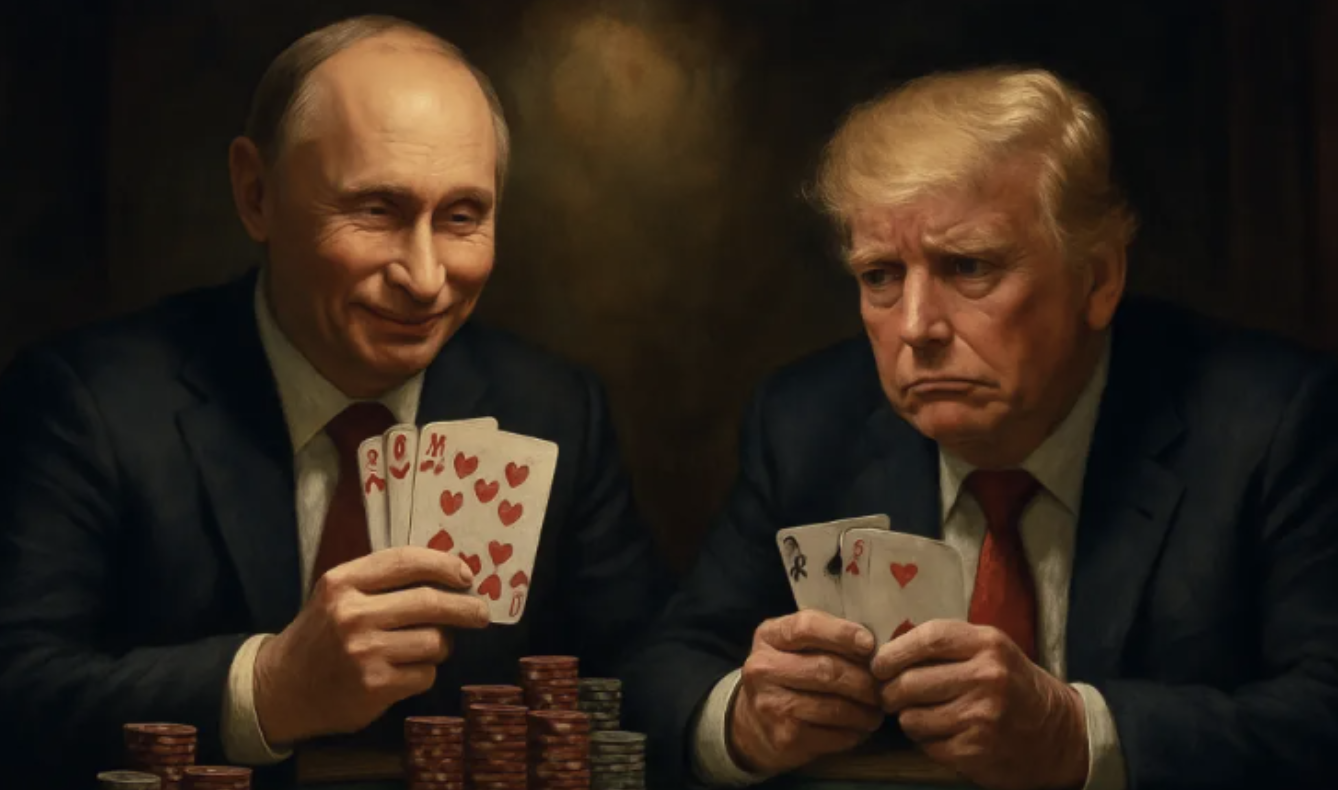
Why Trump’s Russia Tilt Appears Rooted in Corruption, Personal Gain, and Strongman Admiration
A growing body of reporting points to a deeper explanation for Donald Trump’s consistent preference for Russia’s interests over Ukraine’s: it aligns with his personal incentives, both financial and psychological. The tilt is less about traditional geopolitical strategy and more about a pattern of corrupt motivations, business entanglements, and the appeal of authoritarian power.
Below is a concise explanation framed around those core motivations, followed by a curated list of strong sources.
1. Financial incentives and potential personal enrichment
Public reporting shows that Trump’s team has supported or floated proposals that would give the United States and private U.S. investors significant access to Ukraine’s natural resources and post-war reconstruction economy. These proposals do not necessarily guarantee specific profit shares, but they create a framework in which politically connected U.S. actors — including individuals aligned with Trump — could benefit financially if Ukraine is pressured into accepting certain terms.
One major component is the Ukraine–United States Mineral Resources Agreement, signed in April 2025. This agreement allows the U.S. to jointly invest in and share future revenues from Ukrainian mineral and energy resources. The agreement does not automatically grant the U.S. ownership of these assets, but it establishes a legal and financial pathway through which American firms — including those with political ties — can secure future stakes in Ukraine’s resource sector.
Several foreign-policy analysts and investigative outlets have noted that resource access and reconstruction rights are likely to become some of the most valuable elements of any post-war settlement. That means the structure of the peace deal matters enormously: a coerced or Russia-favored settlement could make it easier for foreign investors to acquire rights to infrastructure, energy grids, ports, minerals, and other strategic assets.
Crucially, reporting by Foreign Policy indicates that some Trump-aligned negotiators have either considered or discussed frameworks in which the U.S. would obtain substantial revenue rights from Ukrainian energy and natural-resource development as part of a broader “peace plan” — particularly in regions requiring reconstruction or resource redevelopment after the war. The underlying incentive structure is real: a peace agreement that accepts Russian territorial gains or weakens Ukraine’s negotiating position would make it easier for outside actors to enter Ukraine’s economic sectors under favorable terms.
While no document proves that Trump or his associates would be guaranteed specific profits, the opportunities for enrichment clearly expand under the types of peace terms his administration has advanced. These incentives align with Russia’s strategic goals, because Russia benefits from a settlement that weakens Ukraine — and U.S. actors could benefit financially from the economic vacuum that follows.
2. Corrupt bargaining dynamics with authoritarian leaders
Trump’s foreign policy consistently frames diplomacy as transactional:
“What can I get from the strong guy?”
Putin — an authoritarian with centralized control over military, energy, and state finances — can offer Trump political help, disinformation support, business connections, favorable commercial arrangements, prestige, and personal validation.
Ukraine — a democratic government resisting invasion — cannot offer those things. Putin offers Trump what Trump personally values. Zelenskyy does not.
Recent reporting revealed that Trump’s Special Envoy Steve Witkoff communicated directly with Kremlin officials about Ukraine’s negotiating stance — prompting bipartisan calls for his dismissal. This reflects a recurring pattern: Trump collaborates most closely with leaders who can operate in opaque, corrupt channels.
-
US peace plan for Ukraine drew from Russian document, sources say (Reuters)
The Trump administration leaned on a document originally drafted by Russia in crafting its own peace plan — meaning the U.S. essentially adopted Russian-demand terms.
A handful of US representatives have reacted furiously to a leaked recording in which the special envoy to Ukraine reportedly coached Moscow on how to handle Donald Trump, but most have so far remained mute on the revelation that American officials were advising a US adversary.
3. Authoritarian admiration and “strongman worship”
Scholars and former advisers describe Trump’s worldview as deeply shaped by personal admiration for powerful autocrats who rule without constraints. This includes Vladimir Putin, Viktor Orbán, Xi Jinping, and Mohammed bin Salman.
Trump frequently praises them for:
- “Strength”
- “Toughness”
- “Being in total control”
- “Respecting him”
Psychologically, Trump identifies with Putin, not Zelenskyy. Putin fits Trump’s idealized notion of the powerful, unencumbered ruler. Zelenskyy — a democratically elected leader who challenges corruption and seeks collective Western security structures — does not.
Trump often dismisses democratic leaders as weak, ungrateful, overly procedural, and “not giving him what he wants.”
4. Desire to dismantle Western alliances that constrain him (which aligns with Russia’s goals)
Corruption also works through motivation: authoritarian leaders gain more freedom when institutions and alliances are weakened.
Trump has long expressed interest in:
- Undermining NATO
- Reducing U.S. commitments to Europe
- Pressuring Ukraine to accept Russian territorial gains
These goals are identical to Putin’s strategic objectives. Supporting Russia (or forcing a Ukraine “deal”) therefore becomes a way of weakening the structures that constrain both Putin and Trump.
5. Trump’s business history: opaque foreign funding, laundering risks, and dependence on Russian-aligned capital
Long before politics, Trump’s real estate ventures were buoyed by inflows of capital from Russian and post-Soviet oligarchs.
Independent analyses and congressional investigations found:
- Significant Trump real-estate purchases by shell entities linked to ex-Soviet elites
- Trump Organization projects involving partners connected to Russian and Central Asian money networks
- Patterns consistent with laundering or foreign-influence vulnerability
These networks make Putin’s system materially useful to Trump.
- Following the Money: Trump and Russia-Linked Transactions From the Campaign to the Presidential Inauguration (CAP). At the heart of the inquiry into the alleged collusion between Trump and Russia is money. It provides concrete evidence of relationships, methods, and motives.
6. Who is Special Envoy Steve Witkoff?
From Anne Applebaum’s Why Does Steve Witkoff Keep Taking Russia’s Side? (The Atlantic):
A tape of the October 14 conversation has been leaked to Bloomberg. That’s how we know Witkoff suggested to Ushakov that Putin call Trump. He also offered advice about what Putin should say. The Russian leader should flatter Trump, of course, which is standard advice for speaking to the American president: “Compliment him on his great success in Gaza, congratulate the president on this achievement.” After that, Witkoff said, “It’s going to be a really good call.”
Then, Witkoff advised, Putin should impress upon Trump this idea: “The Russian Federation has always wanted a peace deal. That’s my belief. I told the president I believe that.” Together, the two of them would cook up a peace plan, just like Trump’s recent Gaza peace plan.
Ushakov gave Putin this advice. Putin followed it. How do we know? Because Putin did, in fact, call Trump, on October 16. The call lasted for more than two hours. Trump said the call was productive, and that the two leaders would soon meet, potentially in Budapest (which never happened). During his meeting with Zelensky on the following day, he did not offer Tomahawk missiles to Ukraine. Instead, he became emotional and angry.
In keeping with a long-standing Russian demand, Trump tried to persuade the Ukrainians to give up Ukrainian land in Donetsk province that they currently control—land that the Russians have not been able to conquer after more than a decade of fighting. This is what Putin wants: to obtain Ukrainian territory without fighting for it, to weaken Ukraine, and to use any temporary cease-fire as an opportunity to plan the next invasion.
From Craig Unger’s Why Steve Witkoff is Selling Out Ukraine?:
References:
-
Ukraine and Russia Are Both Struggling to Finance Their War (Foreign Policy, shared here)
-
“America Has Dumped a Messy, Sordid Peace Plan on Ukraine” (The Economist, shared)
Volodymyr Zelensky has no choice but to play along and try to improve it.
(Original source: https://www.economist.com/europe/2025/11/21/america-has-dumped-a-messy-sordid-peace-plan-on-ukraine) -
“Republicans Call for Trump Envoy’s Firing After Leaked Kremlin Call” (The Guardian)
-
The most startling U-turn in the history of U.S. foreign policy (WaPo, shared)
After decades of U.S. opposition to Russian aggression, Donald Trump opens a new, alarming chapter. -
“Following the Money: Trump and Russian-Aligned Funding Networks” (Center for American Progress)
- Why Does Steve Witkoff Keep Taking Russia’s Side? (Anne Applebaum, The Atlantic)

