

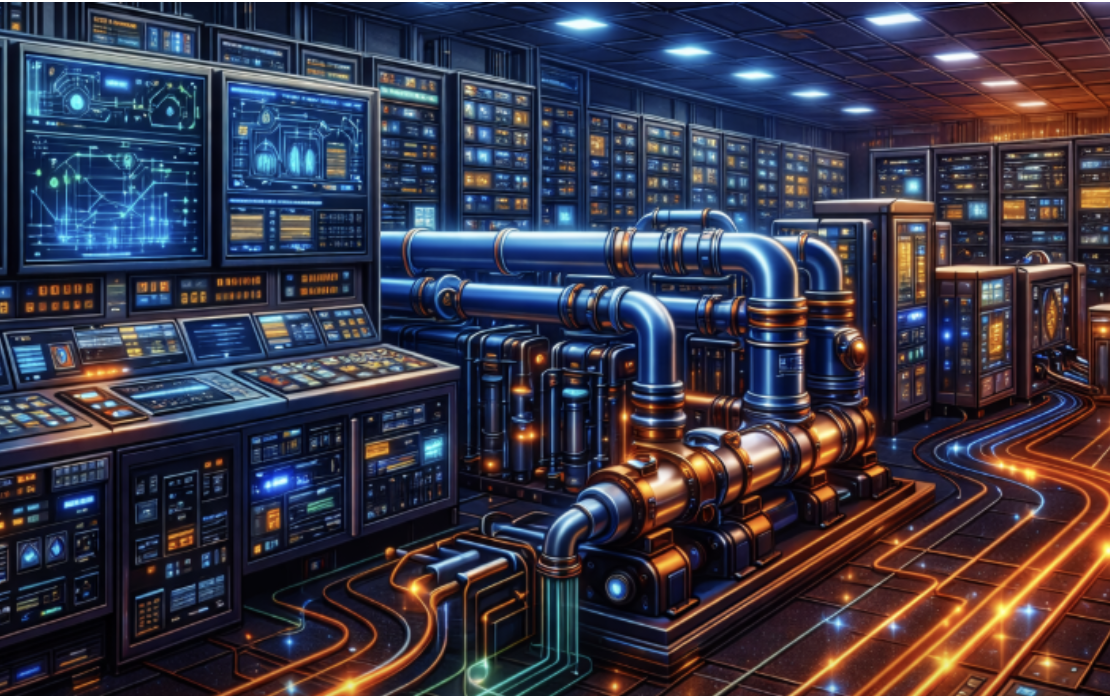
The AI Energy Economy — Part 4: Industrial Automation, Cooling & Controls
The Intelligence Layer of the AI Power System
Artificial intelligence is accelerating electricity demand and, increasingly, concentrating that demand in unusually large, time-sensitive clusters.
Unlike earlier technology waves — microchips, the internet, cloud computing — AI infrastructure does not scale gently. Modern AI facilities require very large power delivery, tight power-quality tolerances, and industrial-grade cooling. In some markets, individual campuses are now planned at scales that begin to resemble city-sized loads, and they must operate continuously, with minimal downtime.
Because of that scale and concentration, the AI power story cannot be understood through any single lens. It spans every layer of the electricity system, from generation and long-distance transmission to what happens inside substations, factories, and data centers themselves.
In Part 2, we examined the companies that build the physical backbone of AI electrification — turbines, transformers, substations, transmission lines, HVDC systems, grid-scale batteries, and the construction required to deploy them.
In Part 3, we focused on the connective and last-meter layers, where power density, heat, and reliability constraints begin to bind as electricity moves from the grid into facilities.
Part 4 builds directly on that foundation. Where Part 3 explained where AI power systems begin to strain, Part 4 focuses on what prevents those strains from becoming failures.
This is the intelligence layer of the AI energy economy: the automation, controls, cooling intelligence, and real-time systems that allow AI-scale infrastructure to operate continuously, safely, and reliably.
1. What the Intelligence Layer Does
Companies in this layer do not primarily generate electricity and do not primarily build the grid’s heavy hardware. Instead, they make the overall system function under AI-scale stress.
They help ensure that:
-
electricity flows where it is needed,
-
voltage and frequency remain stable despite massive loads,
-
substations and transformers operate safely under high duty cycles,
-
data centers stay within tight thermal and power-quality thresholds,
-
factories can scale production of transformers, turbines, reactors, batteries, and grid equipment,
-
grid and facility controls respond in real time to demand shifts, faults, and contingencies,
-
backup systems engage cleanly during peaks or instability.
AI does not just require more power — it requires precision, coordination, and automation in how power is managed.
If the physical grid is the skeleton of the AI energy system, this layer is its nervous system.
2. Technology Foundations of the AI Intelligence Layer
2.1 HVDC and Power Electronics: Control at Scale
Most of today’s grid uses alternating current (AC), which is effective locally but becomes harder to manage over long distances and across asynchronous regions. HVDC and modern power electronics improve controllability and help manage congestion, stability, and long-distance transfer needs.
HVDC systems can:
-
move large amounts of power with lower losses over long distances,
-
interconnect regions and strengthen transfer capability,
-
provide fast controllability of power flows, which is valuable under tight operating conditions.
Key suppliers include Hitachi Energy, Siemens Energy, ABB, and GE Vernova.
2.2 Real-Time Monitoring & Control — SCADA and Digital Automation
SCADA (Supervisory Control and Data Acquisition) systems and associated control architectures help operate complex power systems in real time: monitoring flows, issuing protective commands, coordinating switching, and triggering alarms.
Under high, concentrated AI loads, utilities increasingly require:
-
higher-resolution sensing across the grid,
-
faster protection and response mechanisms,
-
predictive analytics,
-
automated substation and transmission controls.
2.3 Factory Automation — Scaling the Energy Supply Chain
The AI power boom is also a manufacturing boom. More transformers, turbines, switchgear, batteries, and cooling systems must be produced without sacrificing reliability. That requires industrial automation: robotics, controls, instrumentation, and software-driven optimization in factories.
2.4 Thermal Cooling and Controls — Keeping Compute Usable
Almost all electricity consumed by chips becomes heat. As AI rack densities rise, heat removal stops being a background efficiency issue and becomes a hard constraint. Facilities increasingly require liquid cooling, advanced thermal controls, and tightly coordinated power-and-cooling architectures.
Power that cannot be cooled cannot be used.
3. Emerson Electric (EMR)
Stock Price (Jan. 10, 2026): ~$144.20
Emerson Electric is a global leader in industrial automation and control systems, providing:
-
measurement instrumentation and control solutions,
-
process automation hardware and software for plants and utilities,
-
reliability engineering tools used in substations and generation facilities,
-
industrial software that helps manage and optimize complex energy systems.
In the AI era, Emerson’s products are critical across multiple layers of the energy stack — from plant operations to grid controls to reliability systems that prevent cascading failures.
Rating: Buy
A reliable way to participate in AI electrification through automation and operational controls.
4. Honeywell (HON)
Stock Price (Jan. 10, 2026): ~$207.38
Honeywell operates at the intersection of energy systems, industrial controls, and facility automation. Its offerings include:
-
building automation and energy management systems,
-
advanced sensing and safety products,
-
industrial control software and cybersecurity tools,
-
microgrid and distributed energy resource controls.
These technologies are widely embedded in complex facilities, but much of this strength is already reflected in Honeywell’s valuation.
Rating: Hold (watch for pullbacks)
5. Rockwell Automation (ROK)
Stock Price (Jan. 10, 2026): ~$410.53
Rockwell Automation is a core provider of industrial automation hardware and software that streamlines factory operations. In the AI power context, Rockwell’s systems help manufacturers scale:
-
transformer production,
-
turbine assembly,
-
grid hardware fabrication,
-
battery and energy storage equipment production.
Its automation platforms ensure consistency, quality, and throughput as electrification supply chains expand.
Rating: Hold (watch for pullbacks)
6. Vertiv (VRT)
Stock Price (Jan. 10, 2026): ~$163.58
Vertiv specializes in data-center infrastructure, particularly:
-
thermal management systems (liquid and immersion cooling),
-
power conditioning and UPS systems,
-
integrated power-and-cooling architectures.
As rack densities rise, Vertiv’s technology determines whether extreme heat can be removed fast enough for AI compute to run reliably. Its products are at the intersection of electrical delivery and thermal management.
Rating: Speculative Buy
7. Baker Hughes (BKR)
Stock Price (Jan. 10, 2026): ~$49.97
Baker Hughes delivers flexible, firm power solutions and advanced turbomachinery that help stabilize grids with variable loads. While not a frontline grid operator, its equipment supports:
-
aero-derivative turbines for fast response,
-
hydrogen-ready turbines and flexible generation assets,
-
controls and stabilization gear for grid reliability.
This plays into the intelligence layer by providing systems that respond to sudden load shifts or contingencies.
Rating: Buy
8. Rolls-Royce Holdings (RR)
Stock Price (Jan. 10, 2026): TBD (non-U.S. ticker)
Rolls-Royce is developing a government-supported small modular reactor (SMR) design targeting modular ~470 MW units. While timelines remain long and execution risk is significant, the company’s work represents a potential future source of firm, controllable power that complements grid intelligence and reliability.
Rating: Speculative Buy
9. Hitachi Energy
Hitachi Energy is a global leader in HVDC technology, transformers, grid automation, and power electronics — central to real-time control and stabilization under stress. It is not a standalone public equity in the U.S., but its technologies are foundational to transmission and SCADA modernization.
Anchor theme exposure (via partner or parent)
10. Mitsubishi Electric (Non-U.S. Listing)
Mitsubishi Electric provides:
-
substation automation systems,
-
power electronics and protection gear,
-
SCADA-adjacent grid monitoring and control solutions.
Its diversified portfolio supports real-time control and reliability, though exposure to pure AI power intelligence is broader and less concentrated.
Rating: Hold
11. SCADA and Real-Time Grid Intelligence Leaders
This broader class includes firms like ABB, Siemens Energy, Hitachi Energy, and Mitsubishi Electric, each providing the sensing, protection, and control systems that modern grids increasingly require as load concentrations grow and reliability margins shrink.
Conclusion: The Intelligence Layer That Makes Everything Work
This section highlights the companies that automate, monitor, cool, control, and stabilize the electricity system at AI scale.
They are generally more diversified and less cyclical than pure power producers, but they are indispensable. AI may accelerate demand for nuclear, gas, renewables, SMRs, batteries, or microgrids — but none of it functions reliably without the intelligence layer.
That makes Part 4 one of the most stable and broadly leveraged ways to express the AI–electricity megacycle: the systems that keep everything operating, regardless of how the generation mix evolves.
References
Emerson Automation & SCADA Systems
https://www.emerson.com/en-us/automation/automation-and-control
Emerson SCADA Systems for Grid Management
https://www.emerson.com/en-us/automation/control-and-safety-systems/scada-systems
Emerson Sustainable Grid Solutions
https://www.emerson.com/en-us/industries/automation/power-generation/sustainable-grid-solutions
Honeywell Industrial Automation & Energy Technology
https://automation.honeywell.com/us/en
Honeywell Data-Driven Grid Control & Demand Response
https://www.honeywell.com/us/en/news/featured-stories/2025/10/utilize-data-for-stronger-power-grids-and-smarter-decisions
Hitachi Energy — Grid Automation Leadership
https://www.hitachienergy.com/us/en/news-and-events/press-releases/2025/09/hitachi-energy-named-world-s-leading-supplier-of-grid-automation-products-and-services
Siemens Energy Grid Automation Solutions
https://www.siemens-energy.com/us/en/home/products-services/product-offerings/grid-automation.html
Rockwell Automation — Data Center Automation Solutions
https://www.rockwellautomation.com/en-us/industries/semiconductor/data-centers.html
Vertiv — Company Overview (Wiki)
https://en.wikipedia.org/wiki/Vertiv
ABB — Power Engineering & Automation Overview (Wiki)
https://en.wikipedia.org/wiki/ABB
Rockwell Automation (Company Profile via Wiki)
https://en.wikipedia.org/wiki/Rockwell_Automation
Hitachi Energy Corporate Profile (Wiki)
https://en.wikipedia.org/wiki/Hitachi_Energy
SCADA in Renewable Energy & Grid Markets
https://www.marketsandmarkets.com/ResearchInsight/scada-renewable-energy-companies.asp
Advanced Distribution Management Systems & SCADA Market (incl. Honeywell, Hitachi)
https://www.marketsandmarkets.com/ResearchInsight/advanced-distribution-management-system-market.asp
AI Energy Economy Series
-
- The AI Energy Economy — Part 1: The Nuclear & Utility Winners of the AI Power Boom (Updated)
- The AI Energy Economy — Part 2: The Pick-and-Shovel Suppliers Powering AI Electrification (Updated)
- The AI Energy Economy — Part 3: The Connective and Last-Meter Layers of AI Electrification (Updated)
- The AI Energy Economy — Part 4: Industrial Automation, Cooling & Controls (Updated)
- The AI Energy Economy — Part 5 (Revised): Merchant Power, Nuclear Scarcity, and AI Contracts

