

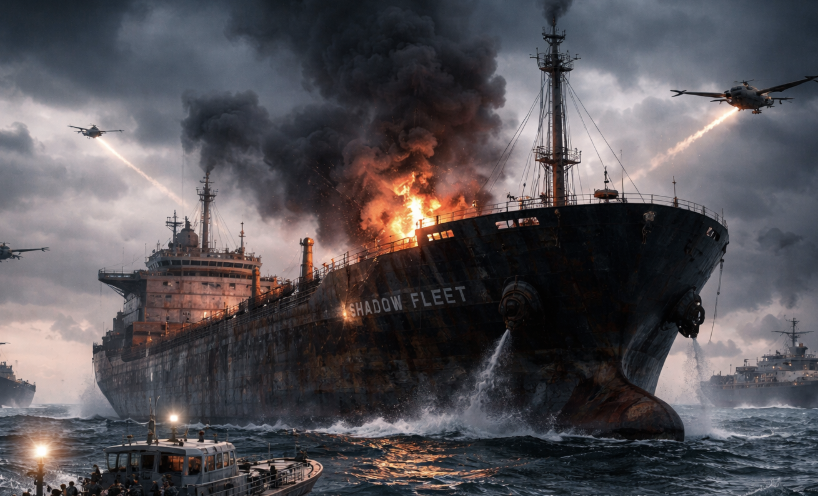
Global oil markets are nearing a massive shock as the shadow fleet edges towards collapse.
With mounting pressure from US seizures, Ukrainian drone attacks, and European interdictions, the roughly 1,000-tanker-strong shadow fleet is in the crosshairs of…everybody. As ships are confiscated, disabled, or destroyed, the numbers stop making sense for captains to run the risk.
Peter Zeihan argues that the global “shadow fleet” used to move sanctioned oil—primarily from Russia, Venezuela, and Iran—is entering a rapid and likely irreversible collapse, with major consequences for global oil markets.
The shadow fleet consists of more than 1,000 tankers operating under shell companies and flags of convenience to evade sanctions, selling crude at discounts and charging risk premiums. That system is now breaking down due to three simultaneous pressures.
First, the United States has escalated enforcement against Venezuelan oil, effectively removing roughly 1 million barrels per day from the market through embargoes and tanker seizures—some targeted at the shadow fleet, others seized regardless of legality.
Second, Ukraine has demonstrated the ability to attack shadow fleet vessels globally using drones launched far from Ukraine itself. Recent strikes have hit tankers and patrol vessels in the Black Sea, Caspian Sea, Russian ports, and even international waters near Libya. This shows that civilian oil tankers are now vulnerable anywhere, sharply raising the risk for operators and crews.
Third, European authorities are increasingly treating the shadow fleet as a military threat. Sweden seized a disabled tanker and found Russian military personnel onboard. Germany and Denmark accuse Russia of using shadow fleet vessels in the Baltic Sea to launch drones over European infrastructure, including airports. This reframes the fleet from a sanctions workaround into a strategic military asset—and therefore a legitimate target.
As attacks, seizures, and breakdowns mount, insurance coverage (largely Russian or Chinese state-backed) is unlikely to pay out, making participation financially irrational. Zeihan argues this will dissuade crews and owners, accelerating a global tanker shortage.
Implications
-
Removing hundreds or thousands of tankers from service would create a severe global tanker shortage, pushing oil prices higher for everyone.
-
Sanctioned producers are hit hardest:
-
Venezuela’s heavy Orinoco crude is extremely difficult to restart once production slows, meaning outages could last months or years.
-
Russia faces a production crisis if it cannot export crude. Shutting down northern Siberian fields in winter risks permanent damage; the last time this happened during the Soviet collapse, recovery took nearly two decades.
-
-
Ukraine is also attacking Russian energy infrastructure directly—pipelines, pumping stations, and refineries—compounding the export and production problem.
Bottom line
Zeihan concludes this is not a single oil shock but a multi-phase, long-lasting disruption affecting both transport and production. With the U.S., Ukraine, and now Europe moving to interdict or dismantle the shadow fleet, he expects escalating seizures, attacks, and enforcement in European waters—and a significant oil market shock beginning next year and unfolding over several years.

