

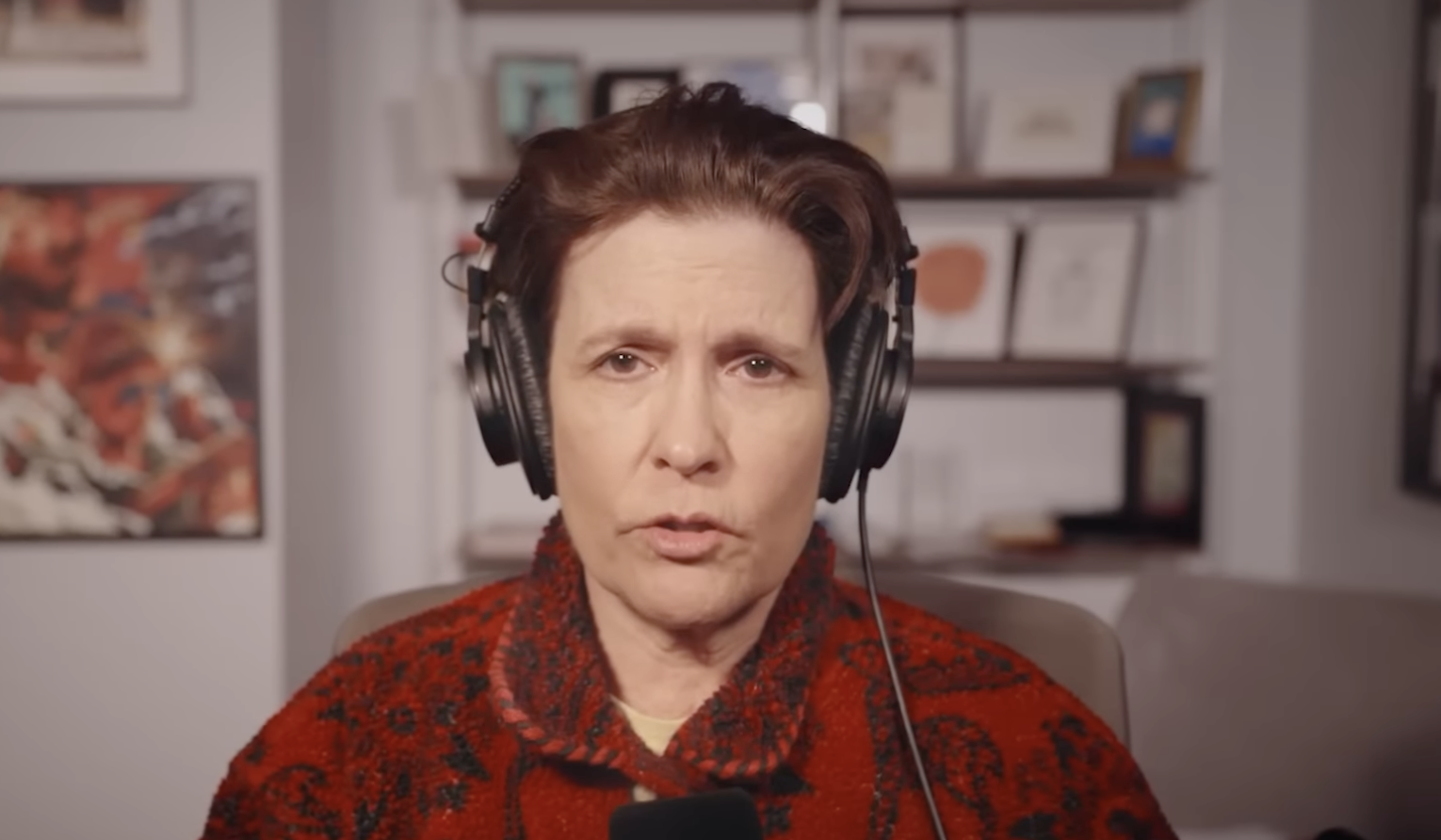
Kara Swisher on AI Bubbles, Big Tech and Life after Trump
The Mishal Husain Show, Bloomberg Podcasts and Bloomberg Television
Timeline
00:00 – Introducing Kara Swisher
01:36 – What to watch in 2026
02:55 – You would be “stupid” to ignore the AI bubble
05:30 – The promise of AI
09:00 – “Serious wealth creates real problems”
13:41 – Steve Jobs was an “adult”
16:23 – “What Tesla did was astonishing”
19:25 – The influence of Peter Thiel
21:07 – Generational shift in tech
25:16 – Swisher’s paying attention to robotics in 2026
28:15 – What Swisher learned from Silicon Valley
30:36 – Swisher’s move into podcasting
34:47 – Life after Trump and why she’s watching KPop Demon Hunters
Summary
Tech journalist Kara Swisher talks with Mishal Husain about AI bubbles, Silicon Valley’s Trump shift, and what to watch in 2026.
Kara Swisher frames 2026 as a year when the tech industry’s power—economic and political—may be tested more directly than it has been in a long time. She says big tech has deep influence inside the Trump administration, and she expects the biggest questions to be whether that influence continues, whether tech valuations remain elevated, and whether AI’s current momentum turns into an “AI bust” or proves durable. She compares today’s mood to echoes of the late-1990s internet boom and crash: huge buildouts, breathless expectations, and a looming question of how patient investors will be if business returns don’t arrive quickly.
Central 2026 watch-list: AI valuations, IPOs, and a possible bubble
Swisher is blunt that it would be “stupid” to dismiss the possibility of an AI bubble. Her reasoning isn’t that AI is a fad—she calls it a major new platform shift—but that the scale and speed of spending are so large that they can create bubble dynamics. She points to enormous data-center buildouts and what she describes as “round-trippy” dealmaking, where companies’ investments and partnerships can start to feel circular, propping up each other’s valuations. She also says Nvidia plays an outsized role in the current cycle in a way that resembles Cisco’s symbolic dominance during the earlier internet boom.
She highlights IPOs as a second storyline: possible offerings like Stripe, OpenAI, SpaceX, and others. IPOs could reinvigorate the tech ecosystem, but she notes the tension: going public can also increase pressure to deliver short-term returns at a moment when the spending curve is steep and the payoff timeline is uncertain. She’s especially interested in a hypothetical SpaceX IPO because she sees it as uniquely dominant in its category, but she also says the “Elon Musk bundle” (X/Twitter, Grok, Tesla) is a drag—particularly because she believes Tesla’s underlying business is deteriorating even if the stock holds up.
AI’s promise, but threatened by politics and funding cuts
Swisher argues AI has real, near-term promise in areas like drug discovery and vaccine development—she mentions lab work and medical applications, and says she’s been focused on health and longevity. But she warns that political choices could shift the benefits elsewhere: she claims Trump-era cuts to research funding are pushing talent and activity to places like Canada. She also emphasizes how hard it is to predict what the “killer apps” will be, comparing today’s AI moment to the early internet era when few could see Uber, Airbnb, or Google coming.
Why her “love story” with tech soured: founders, propaganda, and safety failures
A big arc of the interview is Kara describing her early fascination with the internet—and the moment she realized “everything can be digitized”—followed by disillusionment with the industry’s culture. She says early Silicon Valley leaders were often young and uninformed, and she recalls writing about the “lies” she heard: claims like “we don’t care about money,” “we’re in this together,” and “titles don’t matter.” She’s not saying every founder was malicious; she argues many believed their own mythology. But she thinks that mythology became dangerous once these companies gained scale and acquired what she calls the tools of propaganda: the ability to shape information and behavior at mass scale.
Her key indictment is that tech built products with major “safety” problems and resisted adding guardrails—because founders didn’t feel personally threatened and didn’t prioritize downstream harm. She uses a car-safety analogy: other industries were forced to add seatbelts and airbags; tech largely wasn’t forced to add equivalent protections, especially around privacy and manipulation. She argues regulators and legislators failed to act early, even though history offered plenty of warning about propaganda and autocratic playbooks.
Differentiating tech leaders
Swisher draws sharp contrasts between leaders. She says Steve Jobs could engage with hard questions about safety and privacy like an adult, while she portrays Mark Zuckerberg as reactive and naive—someone who built a powerful information system while underestimating predictable abuse. She also revisits her earlier framing of social media as benign and argues that the industry didn’t adjust enough as the harms became obvious.
On Elon Musk, she says she got him wrong in the sense that she once believed more in his trajectory. She still credits Tesla and SpaceX as astonishing achievements and says Musk spoke early about AI’s importance and danger. But she describes his recent evolution in deeply negative terms, citing obsession, personal instability, and a Howard Hughes-like arc. Her view now is that interviewing Musk is largely pointless because he’s performing as a troll rather than engaging substantively.
On why tech leaders align with Trump, she argues it’s partly expediency and partly genuine belief that Trump is good for business. She describes many CEOs as thin-skinned, impatient, and eager to get what they want immediately—she likens them to “Veruca Salt.” She also says they perceived the Biden administration as less pro-tech and then overreacted, gravitating toward Trump because he’s more openly transactional (donations, crypto ties, “sweetheart deals,” tariff carve-outs). She uses the image of Tim Cook offering Trump a golden statue as an example of behavior she believes Jobs would never have tolerated.
Peter Thiel, in her telling, is consistent—always conservative, not a late convert—and she sees other figures as more opportunistic. The through-line is that when anyone blocks tech’s goals and someone else removes the friction, tech leaders reward the person removing friction, even if it compromises other values.
The AI market structure: dominance, consolidation, and vertical-specific models
Swisher expects consolidation in the frontier-model market. She argues the big general-purpose LLMs largely “do the same thing,” and she’s skeptical that many can ultimately coexist at similar scale. She points out how capital intensity has grown so extreme that some iconic startups would be hard to launch today because incumbents would either outspend or acquire them. Her more optimistic lane is industry-specific AI—models trained or constrained for particular domains (like medicine), where accuracy, curated inputs, and lower hallucination rates matter. She describes these systems as “Google on steroids” when done properly: helpful, personalized, and grounded in vetted information.
What she’s watching most in 2026: robotics
If she had to pick one area to watch, she says it’s robotics—broadly defined, not humanoid showpieces. She argues the public is overly fixated on human-like robots (and she criticizes Musk for hijacking the narrative with theatrical demos). Instead, she emphasizes practical robotics embedded in logistics and industry. She gives the example of Amazon’s Kiva robots and describes seeing the logic of warehouses moving toward far fewer human workers. Her point is that robotics will enter daily life in forms that don’t look like science fiction androids, but will still be transformative.
Media, podcasts, and advice for building an audience
Swisher talks about learning from Silicon Valley’s “startup mindset” and her own shift into podcasting. She describes realizing podcasts reached audiences she wasn’t reaching through traditional web writing, and she frames podcasts as intimate, parasocial, and powerful.
Her advice to Mishal Husain is simple and specific: make something useful, make it interesting, and make it something people can’t get anywhere else (including something that can’t be trivially replicated by AI). She argues you no longer need a traditional studio to produce high-quality broadcasting, and she sees the broader “decimation of media” as something she recognized early—along with the opportunity to rebuild media in new forms.
Where she’s heading next: “life after Trump,” health, and cultural shifts
At the end, she says she’s focused on health, longevity, and tech that improves lives beyond the wealthy—especially after finishing a CNN documentary series. She also signals a desire to move toward “life after Trump” and away from endless conflict driven by social media. She closes on a cultural note, arguing that cultural shifts matter and that she’s interested in media that pushes society toward a more constructive spirit.

