

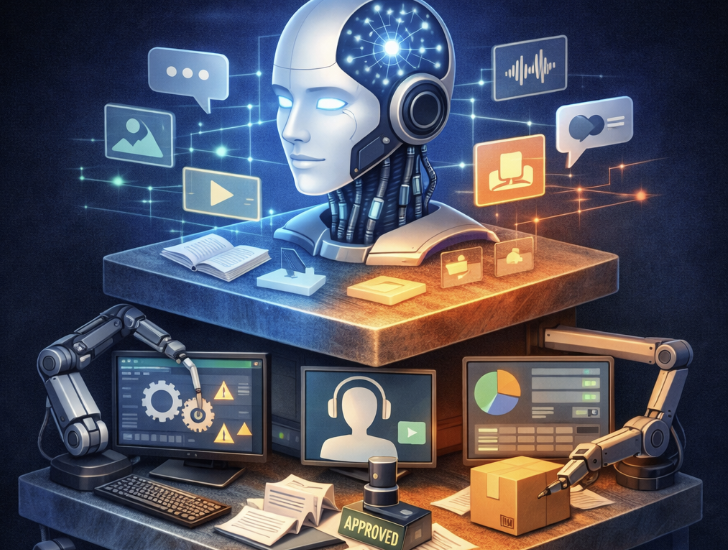
Why the OpenAI–ServiceNow Deal Explains the Next Phase of Enterprise Software
OpenAI and ServiceNow announced a multi-year partnership to embed AI agents directly into ServiceNow’s enterprise software, as reported on January 20, 2026 by The Wall Street Journal in “OpenAI and ServiceNow Strike Deal to Put AI Agents in Business Software.”
According to the report, OpenAI’s models will be integrated directly into ServiceNow’s core workflows, allowing AI agents to operate inside the platform rather than as a separate tool. In practice, this means OpenAI’s models can read requests, interpret context, and take permitted actions within ServiceNow’s IT, customer service, and operations software.
The deal depends on customer usage of OpenAI’s models inside the ServiceNow platform and includes a revenue commitment from ServiceNow to OpenAI, though specific financial terms were not disclosed.
OpenAI executives framed the partnership as a response to growing enterprise demand for AI that operates directly inside business workflows rather than as a standalone application. As OpenAI chief operating officer Brad Lightcap put it, “Enterprises want OpenAI intelligence applied directly into ServiceNow workflows.” He added that customers are increasingly focused on “agentic and multimodal experiences,” allowing them to work with AI “like a true teammate inside ServiceNow.”
The agreement reflects a broader shift across enterprise software, as AI agents — autonomous systems that can take action on behalf of humans — become standard components of core business platforms. For OpenAI, the deal advances its push into enterprise distribution, both through direct model access and partnerships with established software vendors. For ServiceNow, the partnership offers a way to bring advanced AI capabilities into its platform without having to build and maintain frontier models internally.
This matters because it illustrates where artificial intelligence actually creates economic value — and why markets may be misunderstanding what AI means for enterprise software companies.
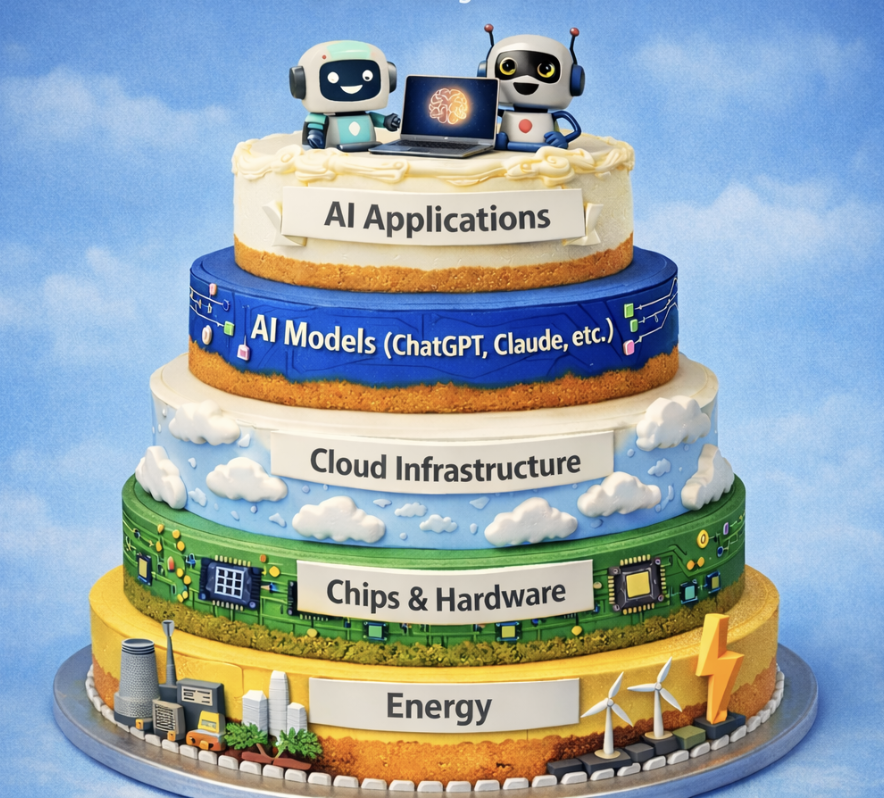
To see why, we need to step back and understand AI not as a feature, but as a platform shift, as described by Nvidia CEO Jensen Huang.
AI Is Changing What Software Is, Not Just What It Does
As discussed in the previous post — “This is a platform shift”: Jensen Huang says the traditional computing stack will never look the same because of AI — Huang argues that generative AI represents a platform shift on the scale of the personal computer, the internet, or cloud computing.
Traditional enterprise software was effectively “pre-recorded.” Humans wrote explicit instructions, carefully structured data, and followed rigid workflows. Computers executed rules; humans did the thinking.
AI flips that relationship. Modern AI systems can interpret unstructured information — language, voice, and images — and respond in real time. Instead of humans adapting to software, software adapts to human intent. Crucially, Huang emphasizes that while AI models attract the most attention, economic value is created in the application layer, where AI is embedded into real workflows. In other words, AI changes the structure of the computing stack itself.
According to Huang, over the past two years AI models advanced faster than applications. The OpenAI–ServiceNow deal signals that this gap is beginning to close.
What the OpenAI–ServiceNow Deal Actually Does
ServiceNow runs the workflows of large organizations: IT tickets, employee service requests, customer service cases, approvals, escalations, and automated actions. It already sits at the intersection of people, systems, permissions, and audit trails.
By embedding OpenAI’s models directly into ServiceNow, AI does not live alongside the software — it lives inside it. This enables what the industry now calls agentic AI: AI systems that don’t just answer questions, but take actions.
In practice, this means AI agents that can read an IT ticket, diagnose the problem, restart a system, access legacy mainframes, update records, and escalate to a human only when necessary. The interface stays the same. The labor inside the system changes completely.
This is the key insight: AI is not replacing enterprise software. It is replacing human labor inside enterprise software.
Why the “Software Gets Replaced by AI” Narrative Is Wrong
A common market fear is that companies will abandon enterprise software and “build their own AI.” In reality, this makes little sense.
Large organizations do not discard systems that run payroll, accounting, compliance, customer data, and operations. These platforms encode decades of business logic, security rules, and regulatory requirements. Replacing them outright would be risky, expensive, and irrational.
Instead, AI changes how work is done inside those systems. Tasks that once required people are automated by AI agents operating within the same governed environment.
This replacement happens in two places simultaneously. Inside the software company itself, AI reduces the labor required to build and maintain workflows. Inside customer organizations, AI agents take over routine digital work. This is a structural cost shift, not a product novelty.
Where AI Replaces Jobs First
The earliest jobs affected by agentic AI share three traits: they live entirely inside software, follow repeatable workflows, and primarily move information.
IT operations and help desks come first. Customer support follows. Back-office roles in HR, finance operations, and compliance are next. Over time, junior white-collar roles are hollowed out as AI removes the need for humans to translate between systems. Senior roles persist, but organizational pyramids narrow from the bottom.
How This Affects the Enterprise Software Landscape
This shift strongly favors companies that already control workflows or systems of record.
While all of the companies discussed here are classified as enterprise software, they do not occupy the same role inside an organization. Platforms like ServiceNow, SAP, Salesforce, and Workday function as systems of record and execution: they run core business processes involving operations, money, customers, and people, and if they fail, the business is immediately impaired.
By contrast, Atlassian and monday.com primarily coordinate work rather than execute it. They organize tasks, projects, documentation, and team collaboration, improving visibility and productivity, but typically do not control permissions, move money, or directly carry out governed business actions. This distinction matters for AI: agentic AI monetizes most effectively inside execution and system-of-record platforms, while coordination tools benefit more from assistive AI and face greater risk of feature commoditization.
ServiceNow (NOW) sits at the execution layer — where work is created, routed, approved, and completed. It handles IT tickets, employee service requests, customer service cases, access approvals, incident response, and operational escalations. That positioning makes ServiceNow unusually well-suited for agentic AI. AI agents can read requests, diagnose problems, take permitted actions, and escalate only when necessary, all inside a governed environment. The result is immediate and measurable ROI, because AI directly replaces routine digital labor rather than merely assisting it.
SAP (SAP) operates the ERP backbone of large enterprises — the systems that manage finance, procurement, supply chains, manufacturing, inventory, and regulatory reporting. SAP is where money is recorded, goods are tracked, and compliance is enforced. These systems are mission-critical and highly regulated, which slows AI adoption and raises the bar for accuracy and auditability. Once AI is trusted inside ERP workflows, however, the payoff is enormous. Automating procurement exceptions, financial close processes, or supply-chain disruptions can produce large, durable cost savings while further increasing already-high switching costs.
Salesforce (CRM) controls customer-facing and revenue workflows, including sales pipelines, marketing campaigns, customer service interactions, and forecasting. AI improves productivity by drafting communications, prioritizing leads, triaging support cases, and suggesting next actions. The economic impact of these improvements can feel less concrete than in IT operations or ERP, making ROI harder to quantify and increasing pricing pressure as AI features proliferate across CRM platforms.
Workday (WDAY) governs people and payroll — hiring, onboarding, employee records, compensation, benefits, performance management, and, in some cases, core financial planning. AI reduces administrative HR work by automating resume screening, onboarding workflows, employee inquiries, and document processing. Because HR and payroll involve fairness, bias, labor law, and regulatory compliance, AI deployment here is more cautious, even though the long-term productivity gains are real.
Atlassian (TEAM) (Jira, Confluence) is deeply embedded in how engineering and technical teams plan, track, and document work. Its tools are closely tied to software delivery itself — managing bugs, releases, dependencies, and long-lived institutional knowledge. Over time, teams build years of processes and documentation inside these systems, creating meaningful switching costs. AI can improve planning, summarization, documentation, and coordination, but Atlassian’s advantage depends on deep context rather than surface-level AI features.
monday.com (MNDY) is best understood as flexible, visual task coordination. It excels at making work visible, customizable, and easy to organize across teams. Many organizations use Monday as a smarter spreadsheet or project board to track tasks, timelines, and responsibilities. However, it typically sits above execution rather than inside it. The software organizes work, but does not usually perform actions or control critical systems. This “lightweight coordination” makes AI features easier to replicate and switching costs lower unless the platform moves deeper into execution-level workflows.
AI Leverage vs. AI Risk: A Valuation Framework
This brings us to valuation — and why many enterprise software stocks have sold off together.
Markets appear to be pricing in a blunt story: AI disrupts software, therefore software multiples compress. That view misses important distinctions.
A more useful framework weighs AI leverage against AI risk. High AI leverage means AI can be embedded naturally into existing workflows in ways customers will pay for. High AI risk means features are easily commoditized, pricing power erodes, or value shifts toward the AI model provider.
Under this lens, ServiceNow and SAP sit at the top, combining high leverage with relatively lower risk. Salesforce and Workday follow, offering meaningful leverage but facing greater pricing and adoption uncertainty. Atlassian sits in the middle, with leverage tied to deep context. monday.com faces the highest risk unless it increases execution depth and switching costs.
Multiple compression risk is real, but it is not uniform. Companies that turn AI into embedded digital labor are better positioned to defend pricing and expand margins over time.
Bottom Line
AI does not eliminate enterprise software. It reduces human labor inside enterprise software.
As agentic AI spreads, the companies that already control workflows, permissions, and systems of record are likely to capture the bulk of the economic value. Markets focused on “AI replacing software” may be missing the deeper reality: this is a labor transformation event, not a software extinction event.
References & Further Reading
- WSJ — OpenAI and ServiceNow Strike Deal to Put AI Agents in Business Software
https://www.wsj.com/articles/openai-and-servicenow-strike-deal-to-put-ai-agents-in-business-software-57d1da5c?mod=tech_feat1_ai_pos5 - Nvidia / Jensen Huang — World Economic Forum remarks on AI platform shifts
https://www.weforum.org/meetings/world-economic-forum-annual-meeting-2026/sessions/conversation-with-jensen-huang-president-and-ceo-of-nvidia/ - ServiceNow — Now Assist & AI Agents overview
- OpenAI — Enterprise & platform partnerships
https://openai.com/enterprise - SAP — Joule AI and embedded AI strategy
https://www.sap.com/products/artificial-intelligence.html - Salesforce — Agentforce and Einstein AI
https://www.salesforce.com/artificial-intelligence/ - Workday — AI & Illuminate platform
https://www.workday.com/en-us/products/artificial-intelligence.html - Atlassian — AI in Jira & Confluence
https://www.atlassian.com/ai - monday.com — Monday AI

